 | CANADA |
HARRINGTON HARBOUR part III
I was up; bright-eyed and bushy-tailed, early next morning which was just as well, because the weather was showing dramatic signs of improvement. So after a healthy breakfast, Jean, my landlady, kicked me out of the house and packed me off on my travels so that I could see what there was to see.

And the answer to that question was "a lot more than I could see yesterday", which was just as well, because it was really sad to have come all this way for almost nothing in the way of proof that I was ever here. This morning, I could actually see where I was going, which is always useful.
First stop had to be back up the top of the hill behind the house - the hill where I'd noticed the cairn yesterday. I couldn't see a thing when I was up there then, and there was much more chance of seeing something exciting today.

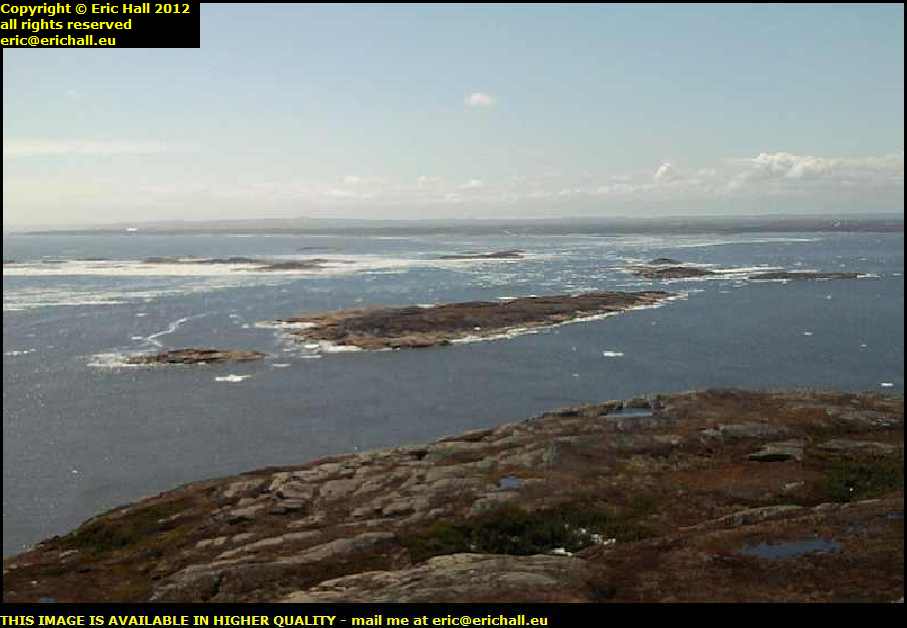
There's quite a narrow Sound at the back of Harrington Harbour with an island across the way. The Sound was, of course, still totally iced up as you can see.
Something else that caught my eye was the fact that there were several houses over there and that from what I could see, they seemed to be occupied. That might explain why there were plenty of boats in the harbour yesterday - people coming across to see what the Nordik Express had brought them.

Out in the distance behind the island we have the Gulf of St Lawrence again and yet more islands. There are dozens of them all around Harrington Harbour and all of these are known collectively as the Harrington Archipelago.
I have always fancied the idea of having an island all to myself and I reckoned that around here, it would not be all that difficult an ambition to achieve.

From up here at the cairn there was an excellent view of the harbour. I wish that I'd had this view yesterday when there was such a lot going on down there, because today there wasn't all that much happening at all. Not a single ship was there.
You can see that this is an ideal harbour, well-protected from the extremes of weather by the islands just offshore. You'll also notice that it's still pretty-much iced up, even though we are well into May.
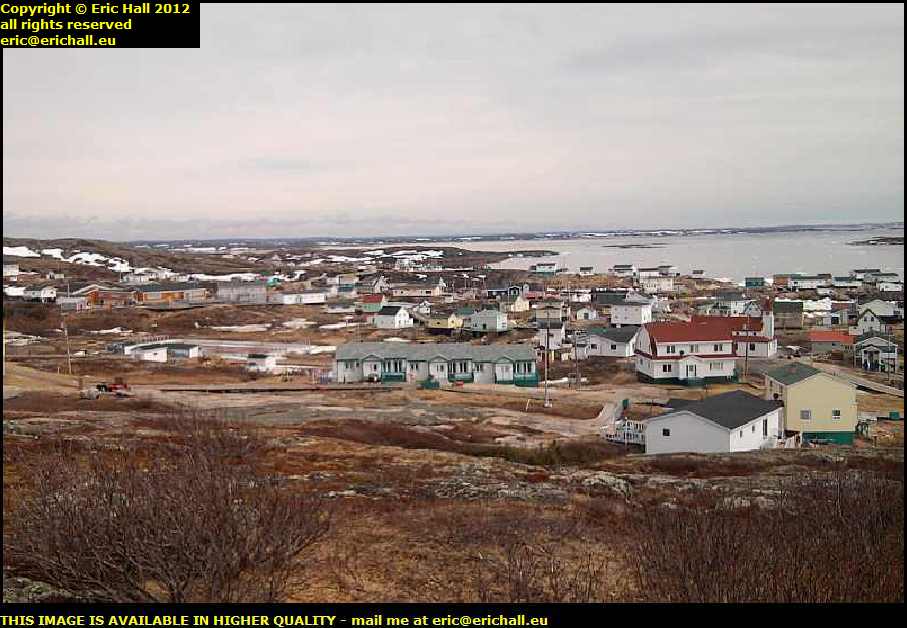
It is said by many that Harrington Harbour is one of the 30 most beautiful villages in Canada, but for all that I saw of it yesterday in the fog, it could have been one of the dingy back streets of the worst suburb in Vancouver and I wouldn't have noticed the difference
Today however, there would be no such issues, and I wouldn't disagree for a minute with the opinion of those who know.

From the cairn I had a walk down to the far eastern edge of the island. There wasn't all that much to see down here except a couple of houses down here and the odd offshore island.
However, I had noticed the vegetation. You will already have noticed that we haven't seen any trees just yet, and this deciduous scrub seems to be what is the underlying vegetation
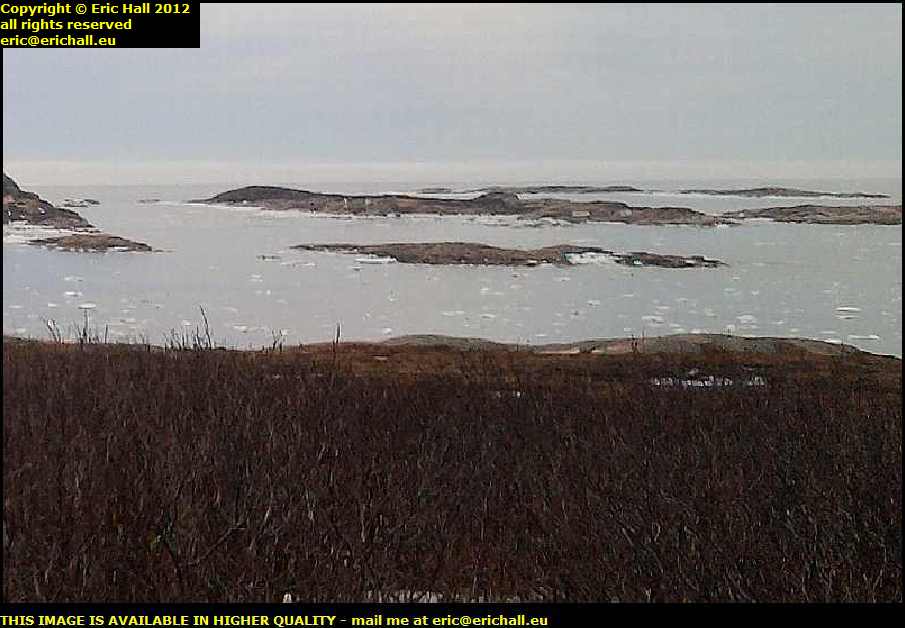
You can see from this vegetation exactly what issues faced the Norse settlers of Greenland. Greenland has something of a similar climate and the habitable parts have similar topographical features to Harrington Harbour, and so the vegetation would have been pretty much the same.
It is therefore easy to understand their enthusiasm upon seeing real trees when they arrived at Vinland, and why the Greenlanders continued to struggle across to "Markland" for the wood as late as the 14th Century despite the dramatic deterioration of the climate during the Little Ice Age.

While I was up by the cairn, my reverie was interrupted by the arrival of a helicopter. Apparently it's not unusual for someone to have his chopper out here and there is a helipad of sorts.
As I've said before, there are hundreds of outlying islands (someone has counted over 600 of them) around here in the Gulf of St Lawrence and communication by boat cannot always be relied upon.
It's quite true to say that anyone who lives his life in a hurry would have no place out here on the Lower North Shore, but sometimes there are emergencies that arise that need to be dealt with before the arrival of the next boat.
The helipad is right by the Grenfell Mission Building and so I wandered off over there for a closer look at the building.

We've spoken about the Grenfell Mission before when we were out in Labrador in 2010 . William Thomason Grenfell founded his first mission and hospital for Labrador fishermen and their families in 1893 and gradually spread up along the Labrador coast. His mission and hospital here on this site date from 1905 (although some say 1907). The building was completely renovated in 1950.
In June 1968 the Grenfell Mission ceased to operate and their final ship, the Lady Grenfell, was withdrawn from service. In 1974, the building here became an Old People's Home. The Rowsell Interpretive Centre that we visited first thing this morning has many original documents and memorabilia relating to Dr. Grenfell and his Mission.
The statue over to the left in front of the building is to commemorate Dr Donald Gordon Hodd. He joined the Grenfell Mission in 1926 and worked as the local GP all the way up and down the coast until he retired, aged 72, in 1970.

With the weather being so much better this morning I went to retrace my steps from yesterday when I was blundering about in the fog and mist down by the shoreline.
Because of the nature of the ground here - tundra and peat-bog with a permafrost subsoil - all of the more popular roadways on the island are these wooden boardwalks. It's for this reason that, I imagine, cars and the like are banned from the island.

Continuing my little walk, that's the bridge that I photographed yesterday, the one where there was the creek that ran out to sea past the houses where there were the private wharfing facilities.
And if anyone has any doubts about the capabilities and the quality of the images of a simple low-reolution camera-phone, I hope that a photo such as this will dispel them.

In the previous photo you will have noticed the ice that was congregating at the mouth of the creek and so I set off down to the end of the path for a closer look.
It's certainly quite impressive, this pack-ice. Watching it swell and surge here with the currents and tides makes it easy to understand how it might be that higher up in the frozen North, countless ships of the early Arctic explorers have been crushed in amongst the ice floes.
From there, there was a pathway that ran up into the hills, a pathway that I had decided against taking yesterday and for two reasons too
No such issues today, though, so off I went, and I'm glad that I did.

Spread out below me was the village of Harrington Harbour, and while you are soaking in the view, it gives me an opportunity to tell you a little something about the place.
The first voluntary settlers (because I'll be discussing the involuntary ones in a minute or two) of European extraction were the typical Newfoundland fishermen who first came here in 1871 for the crabs, lobster, turbot, halibut, cod, and lumpfish.
That's still the principal economic activity of the island and there's a fish processing plant at La Tabatiere further down the coast that deals with the catch.

Prior to that, though, Cartier passed by here on his voyage that began in St Malo on 19th May 1535.
It was after his 50-day crossing of the Atlantic that he began his famous exploration of the north shore of the Gulf of St Lawrence, but his records do not tell us whether or not he set foot on this island.
Nevertheless, one of his ships, the Petite Hermine, was abandoned somewhere along the North Shore at a location that he called Sainte-Croix, and that could be anywhere.
I've not seen any reference to any First-Nation arfefacts having been discovered on the island.
As for involuntary settlers, something that I mentioned a little earlier, there is always the story of Marguerite de La Rocque de Roberval.
The name of Roberval should ring a bell with you because when we were at Vieux Cap Rouge near the city of Quebec a whole lifetime ago, we made a great deal of reference to him.
But to summarise, Cartier's third expedition of 1541 to establish a colony in Nouvelle France should have been under the command Jean-Francois de la Rocque de Roberval but Roberval was late setting off, so Cartier set off alone.
When Roberval did finally set sail, he brought with him Marguerite, a young and unmarried woman who, judging by her family name and his subsequent actions, was a close relative.
During the voyage, Marguerite became the lover of a member of the ship's company, whose name, position and status never seems to have been recorded by history.
It is nevetheless clear that Roberval had power over him, for when he discovered the two lovers together, he marooned them both on an island in the Gulf of St Lawrence, along with Marguerite's maid.
No mention is made as to whether the abandonment was due to his outrage at the couple's behaviour, or whether the behaviour was a good excuse to abandon them so that Roberval could lay his hands upon Marguerite's fortune. It was well-known that Roberval was in desperate financial straights.
Although legend has it that Marguerite gave birth to a child during her stay on the island, she was the sole survivor of the party. It was not until some years later, a passing ship discovered her and returned her to France. She had spent her time on the island living in a cave and chasing wild animals, presumably for food, and a mischievous thought did go through my mind wondering how many of the wild animals ended up chasing her.

There has never been any formal identification of the island upon which she was marooned, and many islands have claimed the (honour) of hosting her during her isolation, but legend has it that one of the more likely ones is Harrington Harbour
A cave here on the island has been claimed as being the one in which she sheltered, but I've not heard any reports of any archaeological exploration of any such cave.
I had a good search through all of the crooks and nannies of the island and this was the only cave that I could find. It's not signposted at all and so I can't confirm that it is the actual cave of the legend.
I did however make a note of its position and location, because knowing all ... "both" - ed ... of my friends very well, considerable sums of money would have been passed to the crew of the Nordik Express to abandon me here. And from what I saw of the island, the human population has long-since done for any edible wild animal that might have been found here in Marguerite's day.
©