 | CANADA |
CLARKE CITY
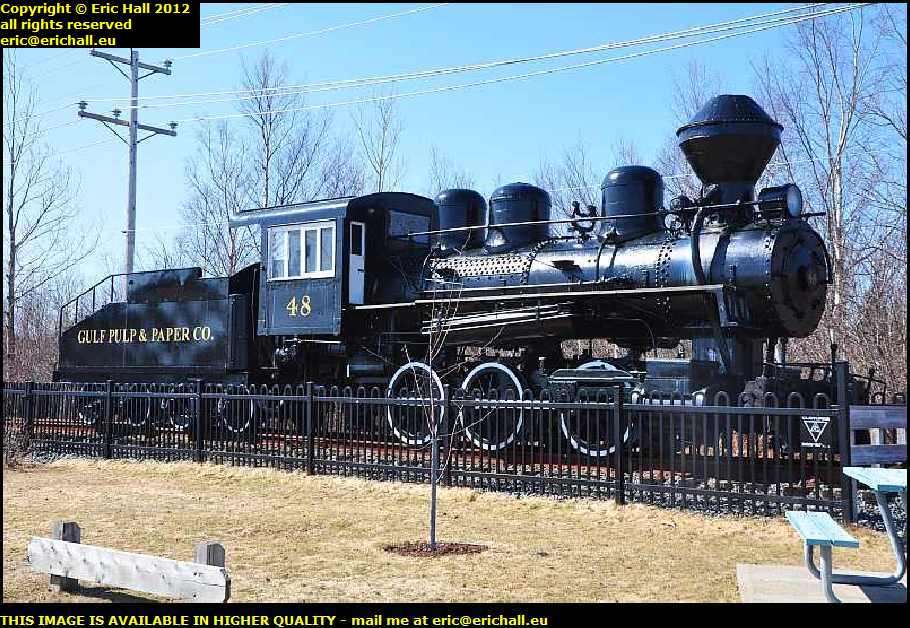
Ohhhh look - a steam locomotive. And haven't we had to wait a long time to see one of these? In fact, I can't remember if we've seen one at all to date in 2012.
When we were at Gallix just now I did mention that over here on the eastern shore of the Riviere St Marguerite there were some things to see here that should not be missed, and you can see that I was right.
This is engine 48 is believed to be a "Davenport of Iowa"-built 0-6-0 of 1931 and formerly supplied to the Dominion Construction Company as locomotive 2185. It came here to Clarke City in 1938.
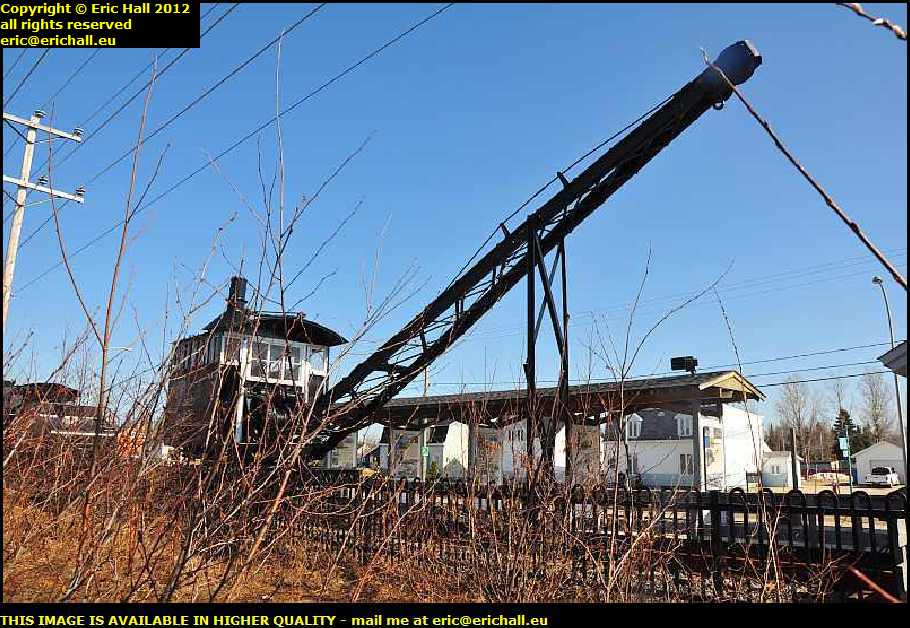
While you admire the symbolic steam locomotive and the symbolic steam crane that is with it, I'll tell you something about the area where we are.
We are in fact in what looks to be the old railway station of what is effectively the ghost town of Clarke City, at the end of what used to be a 14.5-kilometre railway line that was built in 1906 to run down to the river and to Pointe-Noire just outside Sept-Iles, somewhere else that we will be visiting in early course.
The name of Clarke City might ring a bell with you as we have talked about the Clarke brothers before, when we were at Sault-au-Moutons and Forestville the other day.
They were from Toronto and owned a company called the Anglo-Canadian Pulp and Paper Mills Limited. In 1901, having been attracted a couple of years earlier by the potential that this area had to offer, they obtained the concession for a hydro-electric plant here at the mouth of the Riviere St Marguerite and for 2,000 square kilometres of forest for use in the paper industry.
Almost any kind of industrial application needs power and a pulp-mill is no exception. One of the first tasks carried out here was to build a generating plant - a hydro-electric plant as you might expect. And once they had the hydro-electric plant, the Clarke brothers were away.
Buliding work began on the site in 1902 and in 1908 their pulp mill was up and running. In its heyday it was producing 150 tonnes of paper pulp each day.
Of course, there was no workforce in the area and so one of the things that the Clarke brothers built was a "model village", the first significant urban settlement on the North Shore, for their workforce, whom they brought in from elsewhere.
And hereby hangs a tale.
With there being nothing else here, and no other form of access to the site except by the ships owned by the company, the labour force was effectively imprisoned and at the mercy of the employers, who had the monopoly of everything that went on here.
Nothing took place here without the Clarke brothers knowing about it, and no goods were supplied here unless the Clarke brothers supplied it.
The old guy whom I met at lac Labrie was telling me, with some bitterness even now, about the Tommy-Shop that was still in operation here in the 1950s, so he said.
If you don't know what a Tommy-Shop is, then in the UK al least it was all part of a system whereby the employer of a large enterprise such as this would not pay his employees in cash but in tokens. And then, he would set the rents of his houses, and the prices of the goods in the shops, and everything else that he would control, in tokens too.
No money would ever change hands - everything was all done by tokens and the employer would set the costs and the prices at whatever he thought fit.
The employees would have no idea of how much would be the real rate of pay that they would be receiving, no idea of the real prices of the goods and services that they would be buying. And the employer could change everything, devaluing their wages, on a mere whim.
Being isolated out here with no contact with the rest of the country, the employees would have no idea of what was going on elsewhere and what would be the real cost in hard currency of what they were buying.
Any dissent and they would be immediately fired and would immediately lose their homes. And because their pay was in tokens, any savings that they might make would be in tokens and so completely valueless anywhere else. They would be wiped out "at a stroke".
They really were at the mercy of the employers.
That's how a Tommy-Shop system worked in the 19th Century in the UK and I have no reason to suppose that it would be much different than that here in Canada, although I'm surprised indeed to learn that it was still in existence in the 1950s.
However a similar system involving the outlying "liveyer" fishermen of Labrador was in operation certainly well into the 1930s
<
The Clarkes relinquished control of the business in the early 1920s, and the company was sold to Reed Paper in 1961. Despite a great deal of investment, the mill lost its competitive edge and was closed down in 1967.
The entire contents of the plant, valued at $ 6.2 million and a good proportion of it almost new and hardly used, was sold at auction for peanuts on 26th and 27th June 1968 and the buildings were demolished. Local contemporary newspaper reports talk gloomily of the air of depression and despair that existed here at the time.
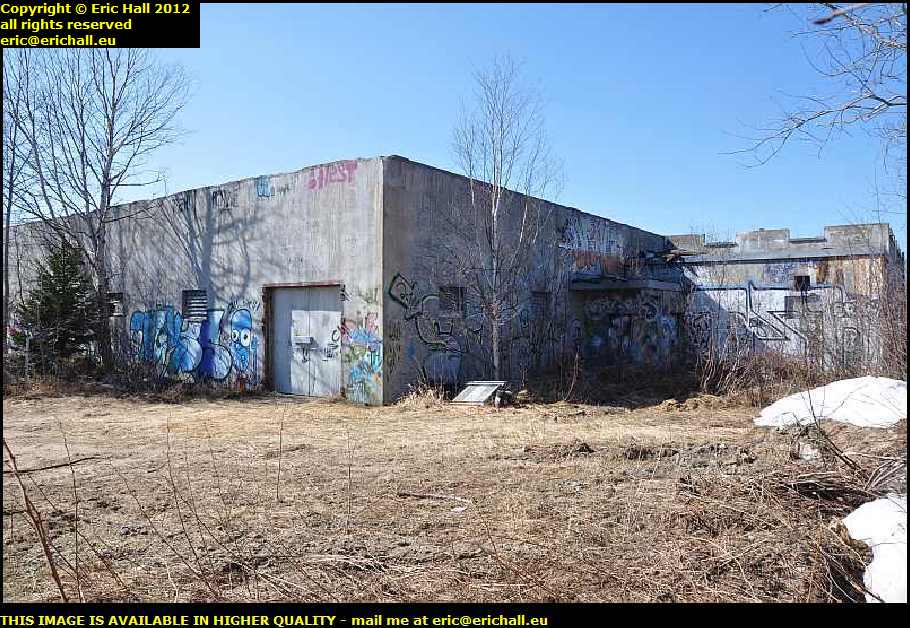
As far as I can see, this building behind the steam locomotive is all that seems to remain of it - there's certainly nothing else here. But this site all around me is flattened and covered in the typical debris that you would expect to see from a flattened factory and so it's a good guess to say that this was where it was situated.
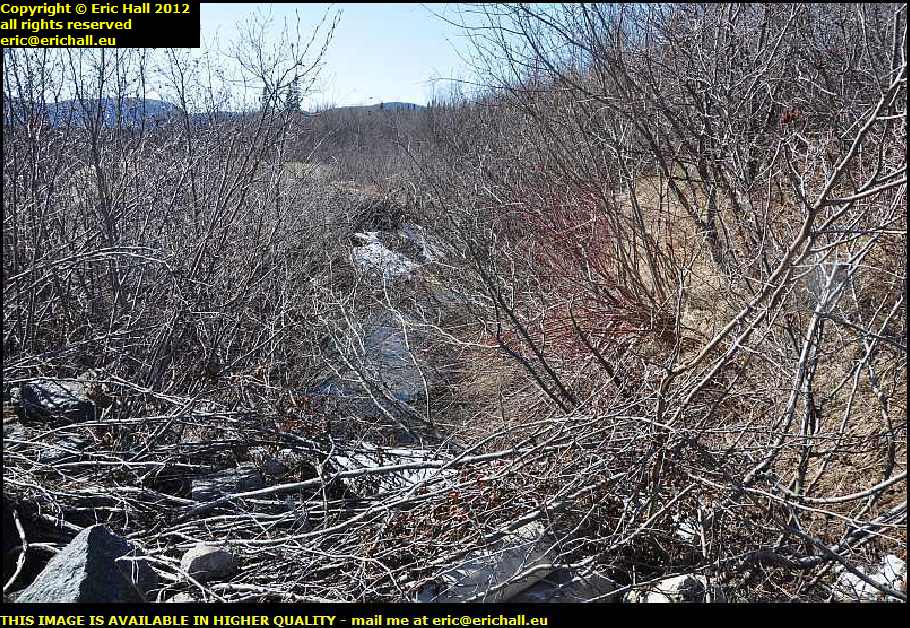
There are some remains of buildings down there, but we can't see them clearly through the branches and it was not possible to approach them for a closer look.
The thought that went through my mind was that the water channel seemed to be artificial and so it was either a mill race to power a water wheel - which is rather unlikely in the early 20th Century although I have seen a suggestion that the mill was mechanically-powered, or else it's the water channel that fed the hydro-electric generators, in which case the building above might have been part of the generating installation.
As you might expect with autocratic Victorian (because we are 50 years behind the times here) industrial empire-builders, the owners of the plant would want to be right on hand so that they could oversee the operations and their employees.
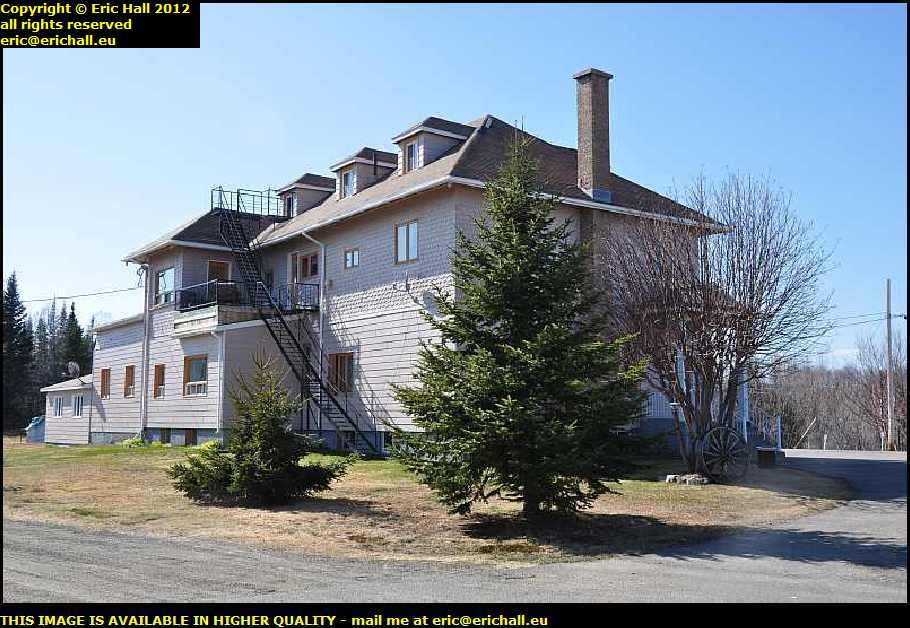
The Clarke brothers were no different whatever in this respect and each one built a house up here on the plateau overlooking the site of Clarke City. This is the house of Frank Clarke, which was nicknamed Château Clarke, or "Clarke Castle".
It's now no longer a stately home, having been converted into apartments, as you can tell by looking at the statutory fire escape which is a later addition to the building to comply with multi-occupancy rules.
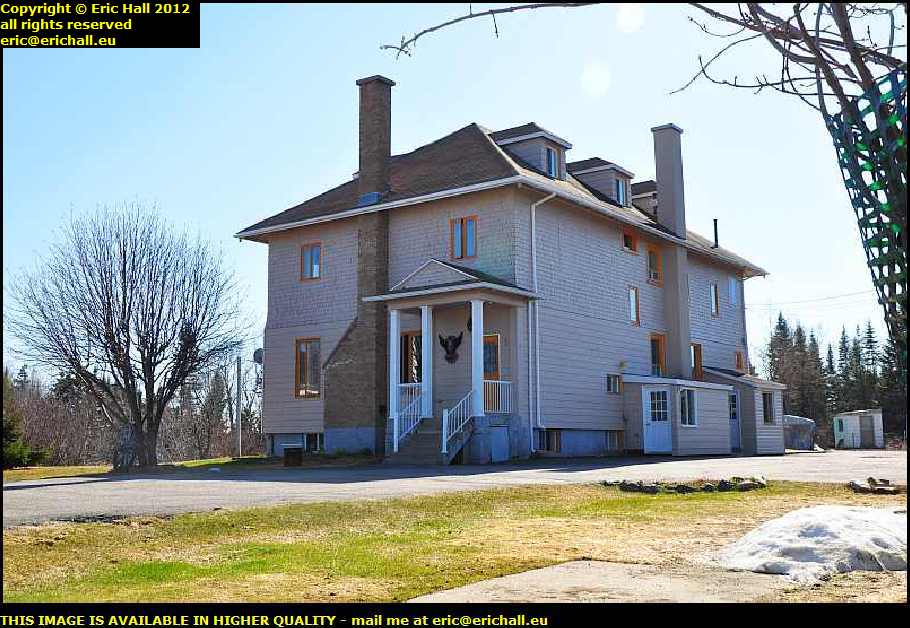
This is not the house of Walter Clarke but a reverse-angle photograph of Château Clarke
Readers of this rubbish who have followed me all the way along Highway 138 from Montreal will not need to be told what became of Walter Clarke's house. You can work that out for yourselves.
For the benefit of new readers to this pages, it suffered the same fate as almost every building in the Province of Quebec at one time or other - it was destroyed by fire, in 1928.
Yes, the amount of arson around in Quebec is astonishing.
There are two ways to continue on my journey - the first being to retrace my steps to the modern Highway 138 and the second to follow the shoreline and the track of the old railway.
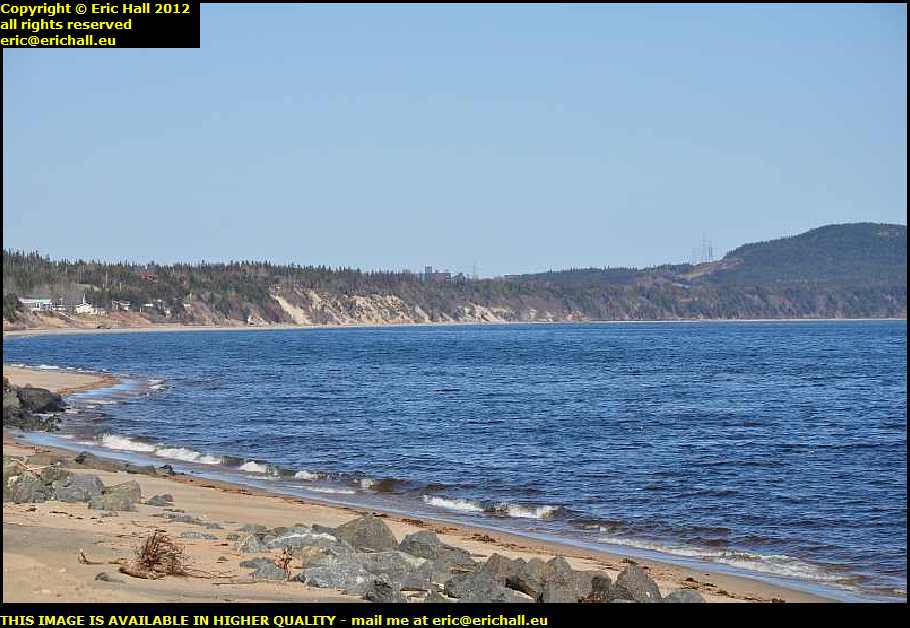
As I want to go to Pointe Noire, the terminus of the old line, the latter seemed to be the most logical route. The fact that I'm a Pisces and thus a lover of aquatic scenery was totally irrelevant.
This was definitely the correct choice because the view and the beaches here were both quite stunning. I'd love to live in one of those homes along the shore just there.
But it's ironic that I saw this headland - Pointe Noire - from my lunch-stop at Gallix and that seemed to be about a year ago. I've travelled for hours and for kilometres too and I don't seem to be any closer to my destination.
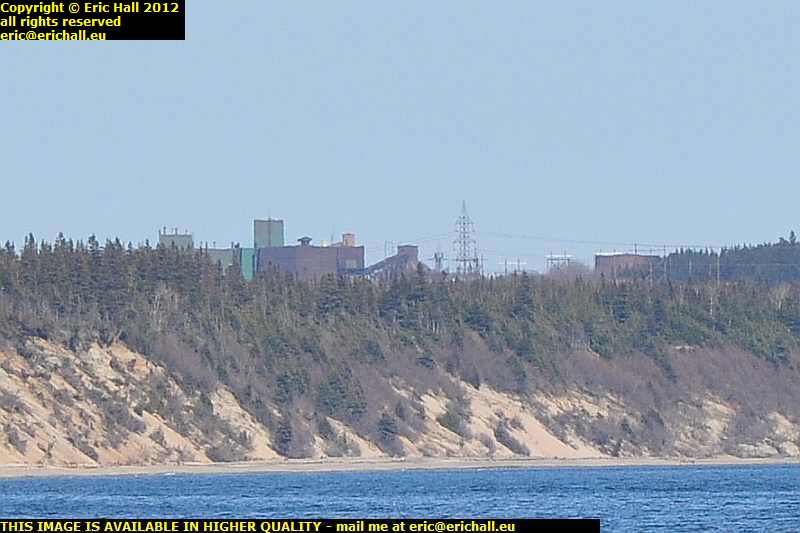
In the previous photograph, I noticed an enormous building on the skyline that looked as if it might have been built out of brick and that arounsed my curiosity as you might expect.
I cropped out a part of the photo and blew it up (I can do this kind of thing despite all of this terrorist legislation) and so I can see that it isn't built of brick at all. It's some kind of large industrial plant and that tells me that in fact I am nearing my destination.
©