 | LONDON |
LONDON EC 1 and a bit
Clerkenwell Road is a comparatively modern street dating from 1878, and cost the sum of £1,600,000 when it was built. It provides a thoroughfare from the top end of Holborn near to Gray's Inn, following for a short distance the line of the narrow Liquorpond Street. It then cut an entirely new route out towards Shoreditch and Hoxton.
Prior to this road, the area was a warren of narrow streets containing some of the worst slums in the city. But this has been said about so many areas of London.
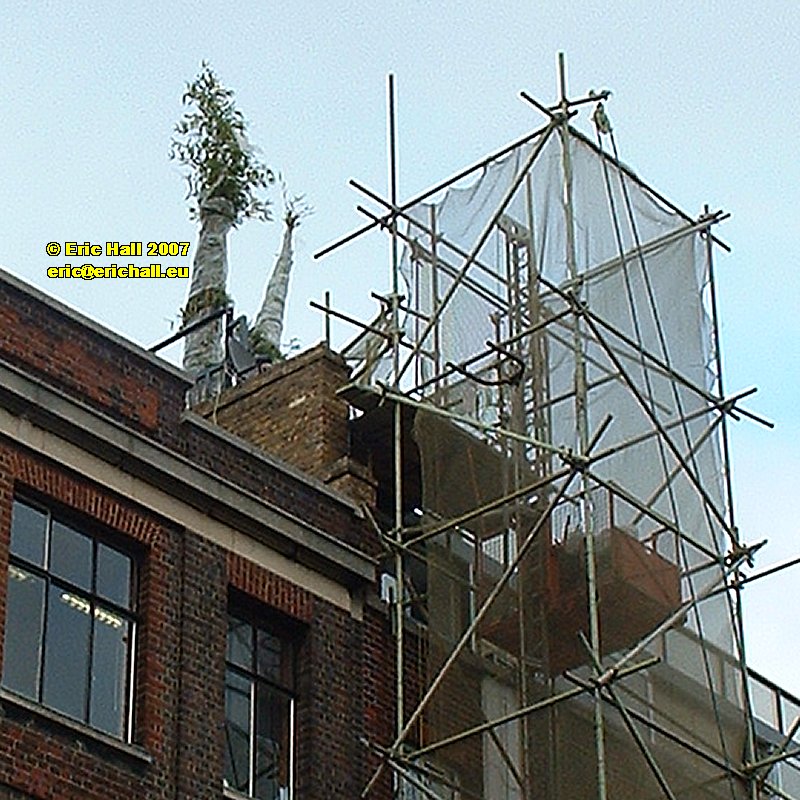
To have lived in some of the worst slums in London must have required a sense of humour, and it's nice to see people perpetuating local customs. Liz and I tried to make up our minds as to whether or not the purpose of the lift was for someone to go up there and water the trees in time of drought.
This area is said to be the home of the city's clock and watch makers. All I can say is that there is no excuse for not knowing when it's time to water the plants.
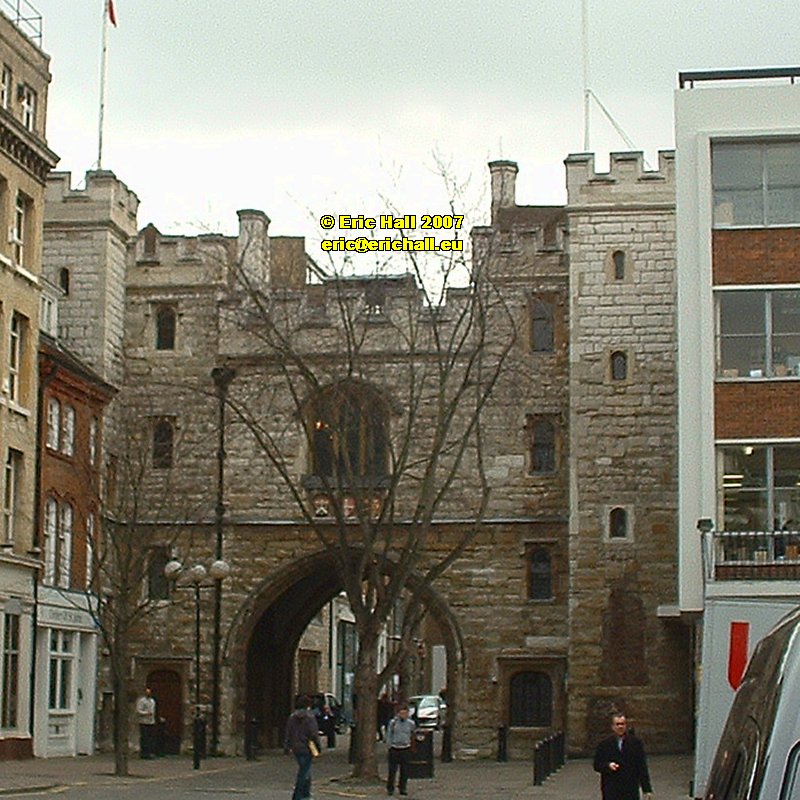
This is the southern part of St Johns Square, which was cut in half by the new Clerkenwell Road. The gate is the old gatehouse to the priory of St John of Jerusalem, effectively the English headquarters of the Knights of St. John who fought in Palestine and Mediterranean islands such as Rhodes and Crete. It dates back to 1140 - but the gatehouse itself was much restored in 1504 and it is said that after that and a subsequent restoration, there is nothing left that is original.
You can see that much of the surrounding building is new, but this is due to heavy bomb damage. The area was devastated in World War II but somehow the gatehouse survived.
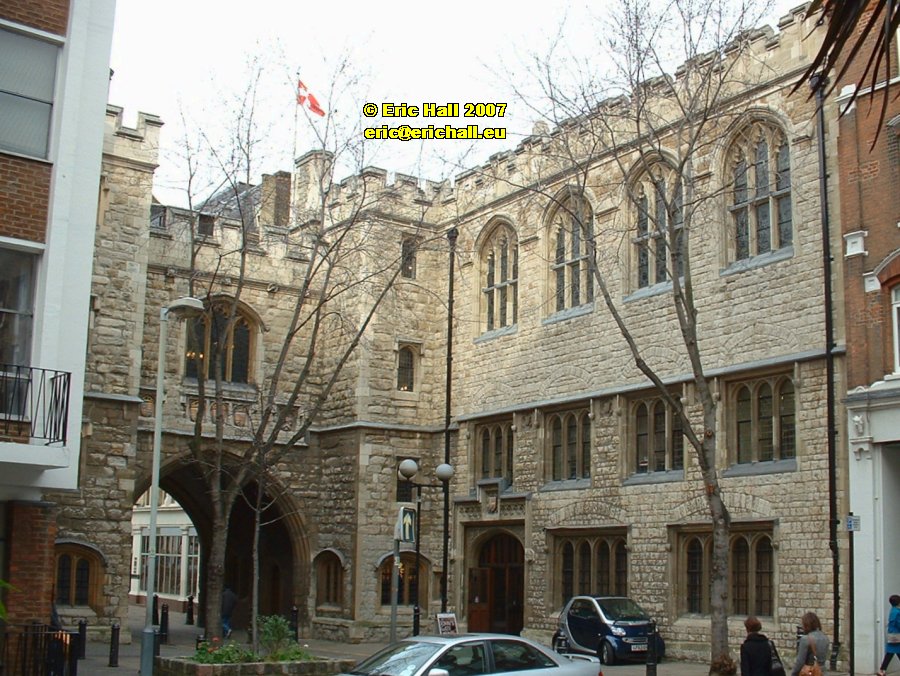
The former priory gatehouse has served as an office for the Master of the Revels. This is the person who was responsible for the censorship of stage productions, effectively the predecessor of the British Board of Film Censors. Edward Cave had the printing press for his "The Gentleman's Magazine" here, and the rooms over the gateway were where Doctor Johnson is supposed to have written many of his articles for the magazine.
Another famous inhabitant was the painter William Hogarth, who lived here as a child. It was his father who ran the famous "Hogarth's Coffee House" from here at the turn of the 18th Century. It is said that Latin lessons were given with the coffee. Well, "puer amat mensam", say I.
It subsequently became a tavern, but was in such a bad condition that in July 1845 it was declared to be such a dangerous structure that it should be demolished. A public subscription was called for, but it took a considerable while for the necessary sum of money to be raised.
The Order of St. John repurchased the gatehouse and the neighbouring Edwardian building sometime in the 1870s. It is now used as a museum of the Order of St. John and of the St. Johns Ambulance Brigade, which was founded by the Order.
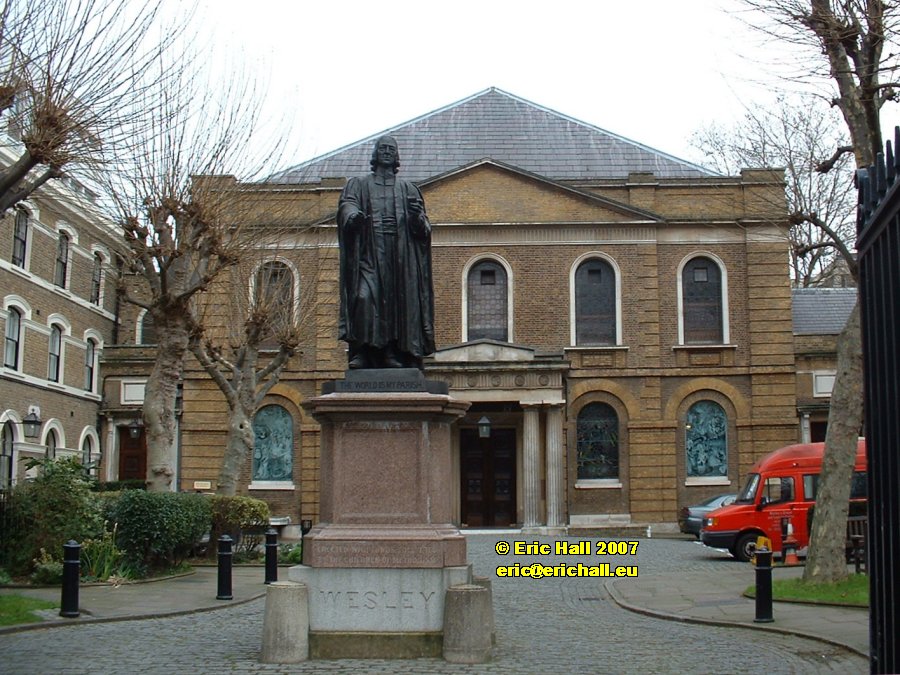
Further along from Old Street, in City Road is the house and museum of John Wesley, the Methodist preacher. The museum was formerly the second chapel of John Wesley in London, he having received an acre of land here from the City of London in 1776.
As one of those curious coincidences that occur every now and again, the land had previously been used as the spoil heap from the construction of St. Pauls Cathedral following the Great Fire of 1666.
The chapel was designed by George Dance the Younger, who was surveyor for the City of London and built by Samuel Tooth, one of Wesley's congegration. The first service was held here on All Saints Day 1778.
It has been restored on many occasions, most famously after it was discovered to be structurally unsafe in 1972 and threatened with demolition. Almost £1,000,000 was raised to restore it, and it reopened on All Saints Day 1978 - exactly 200 years after it first opened to the public. It is now a Grade 1 listed building.
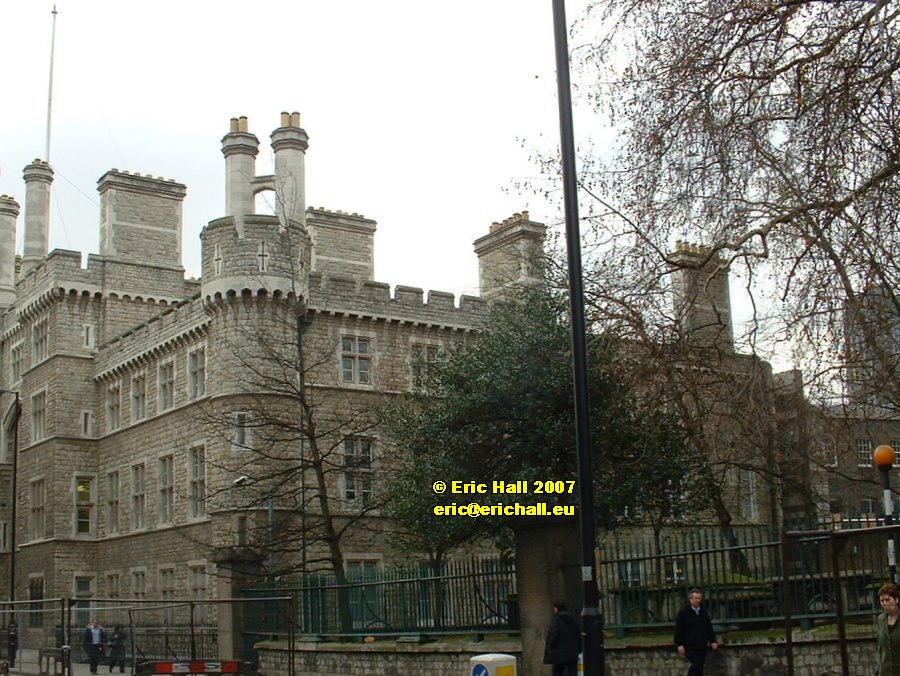
These are the premises of the Honourable Artillery Company here in City Road. I'm not convinced that it is particularly honourable to blow the PBI to smithereens with a cannon, but it was probably different in 1537.
In that year, the gentlemen of the Guild or Fraternity of St George were granted a Charter by King Henry VIII so that they might assist in "the better increase of the Defence of this our Realm and maintenance of the Science and Feat of shooting Long Bows, Cross Bows and Hand Guns".
From that date they became known as "The Gentlemen of the Artillery Garden", and they form the oldest military body in the UK.
What you can see behind the wall and railings is the parade ground. This was formerly concealed behind houses but they were all mostly destroyed in the Blitz.
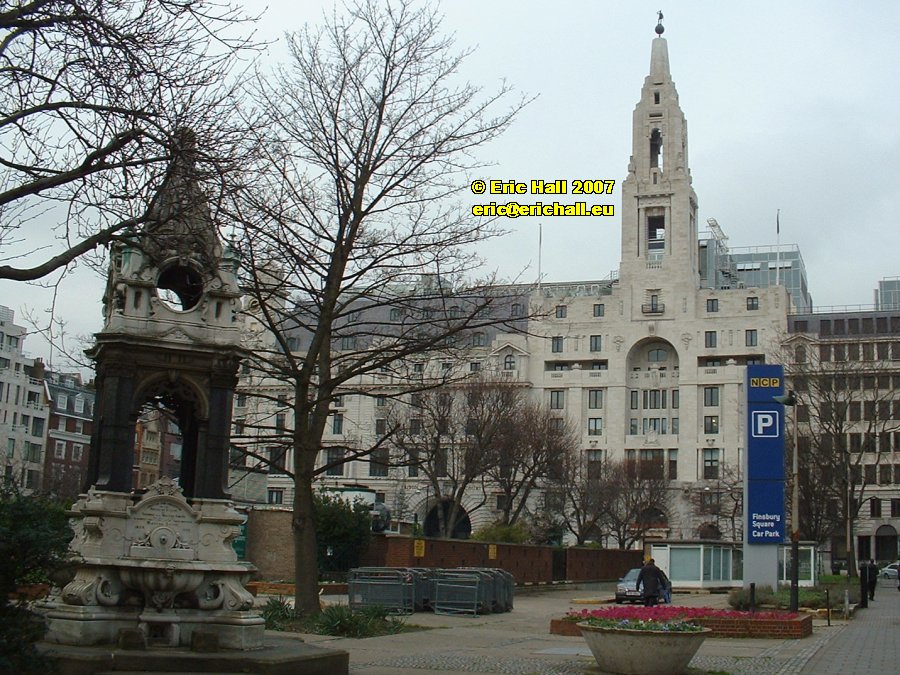
A little way further down the City Road is Finsbury Square, the showpiece of which is the magnificent Triton House, formerly the Royal London House, named after its fomer occupiers, the Royal London Assurance Company. The building is 220 feet (70 metres&) high, and is surmounted by a statue of the god Mercury. People who know their motorcycles can be excused for asking if the building has a featherbed frame.
In the mid 19th Century, Finsbury Square was said to be the most fashionable medical centre of London. It was said in the The New British traveller
My own opinion is that a nice, decent bit of neo-Art Deco adds character to anything, if you can't find any Gothic Revival architecture hanging around.
The car park underneath the square has an interesting history too, which you may well be surprised to hear. It originally started out as a communal underground air-raid shelter in World War II
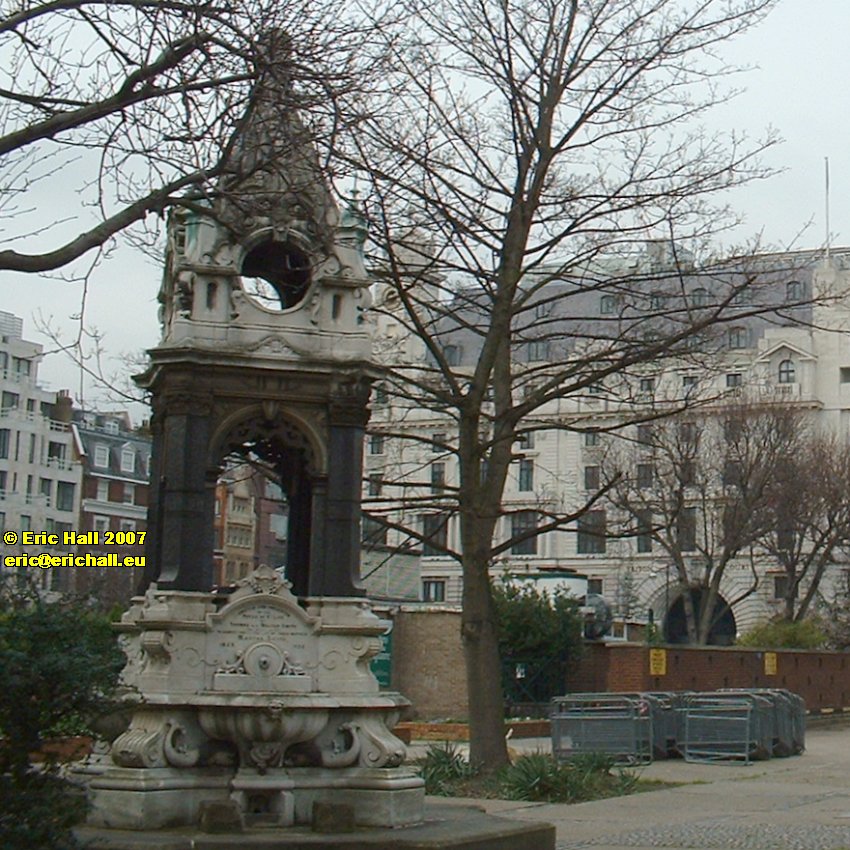
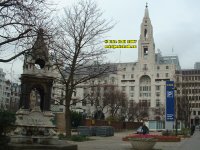
The statue just here is actually a drinking fountain erected by the Metropolitan Drinking Fountain and Cattle Trough Association. This Association was formed in 1859 as the Metropolitan Free Drinking Fountain Association by the M.P. Samuel Gurney.
Gurney had been influenced by a paper read to the National Association for the Promotion of Social Science the previous year concerning the dreadful quality of drinking water available to the poor in London.
This had been identified by John Snow, surgeon, anesthesiologist and pioneer of epidemiology, as the source of what he described as "the most terrible outbreak of cholera which ever occurred in the kingdom" in 1854.
The Association aimed to provide free, filtered drinking water to the poor of London, and attracted the support of Prince Albert and the Archbishop of Canterbury. Its first fountain at St.Sepulchre's church on Snow Hill was opened on 21 April 1859. By 1870, the Association had installed 140 fountains in London.
©