|
CHEMIN DU ROY |
|
|
CHEMIN DU ROY |
CHAMPLAIN
So having dealt with Cap de la Madeleine it's time to move on and I'm soon back on Highway 138 and my drive along the north bank of the St Lawrence.
I'm quickly distracted - "no surprise there" ...ed -by someone in a small village along here having his driveway rebuilt, and he has a compactor here doing it. Yes, a private driveway. Do you remember in 2010 when we were in Labrador and I saw, I think, two compactors working on all those roadworks over the length of about 2000 kilometres of road, and yet here's one in a private driveway.
And in what can only be described as a first for me in North America, I've actually blown my horn at another motorist. This is astonishing, isn't it? Mind you, it was for nothing sinister. He was … errr … distracted at the traffic lights at a set of roadworks.
Yes, roadworks. Roadworks are great. It IS just like being back in Labrador.
I also took some time out to stop at a garage sale along the road. Not to buy a garage of course, but a garage sale is the nearest that you will come in North America to a good old French brocante. Now that I am a Canadian property-owner, I ought to start acting like a Canadian.
There was nothing particularly exciting here but I did find a plunger-operated coffee percolator thing, all for $1:00, or a "looney" as I ought now to be saying. You can't grumble at that price. All I need to do now is to find some plunger-operated coffee.
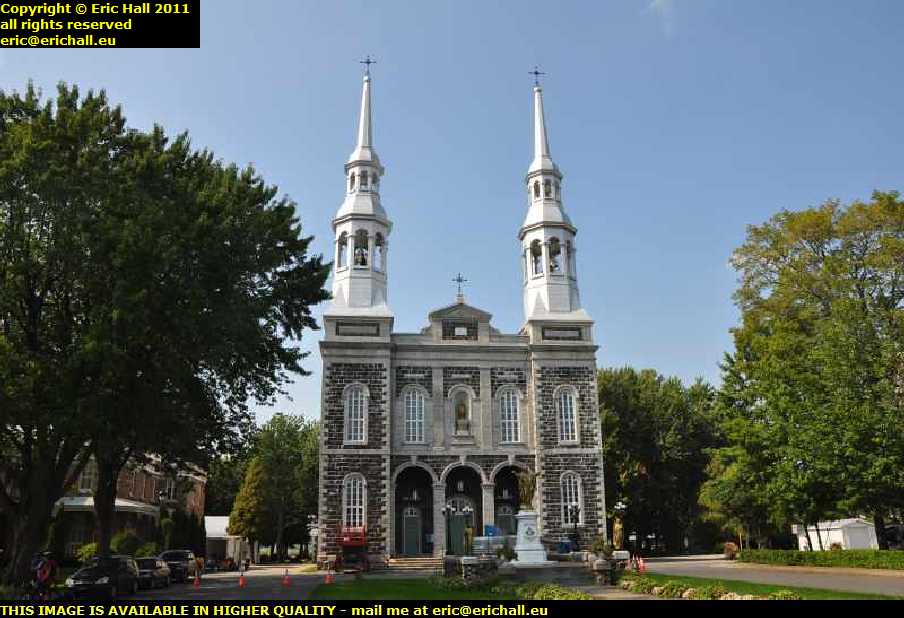
Here's a gorgeous church along the highway. It's the Church of Notre Dame de la Visitation in the small town of Champlain. That's about 15 kilometres out from Cap de la Madeleine. There are no prizes, by the way, for guessing who this town is named after.
The church was built in 1879, replacing an earlier church of 1710 and that is surely a tragedy. The earlier church must have been of quite some historical significance in this kind of area where history seeps from every stone (I can't think now what I must have been drinking when I was dictating these notes. Root beer surely doesn't have this effect).
Inside the church is a consecrated stone, donated to the parish by the second Bishop of Québec, Jean-Baptiste de la Croix de Chevrières de Saint Vallier (did you get all of that?) in 1681.

The above photo was taken as I passed by here in early September 2011. I came by here in late April 2012 and took another photo of the church, but from a slightly different viewpoint where I can see more of the side of the church, and also the beautiful "North American Elegant" building next to it.
You can see my point though about travelling around taking photographs in the early spring. You can see so much more of everything before the leaves appear on the trees.
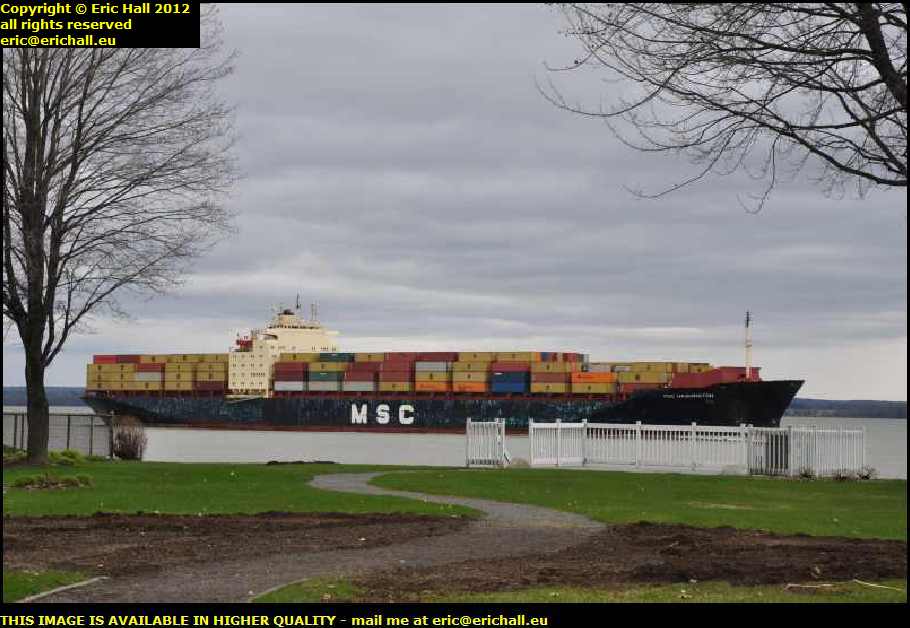
Why I stopped here in 2012 was not necessarily to take another photo of the church but to take a photo of this magnificent container ship that was busily sailing up the St Lawrence as I was driving along.
She's the MSC Washington, built in 1984 in Odense, Denmark, and displacing 43332 tonnes. Although she's owned by Costamare Shipping Company of Athens and flies the Greek flag, she is one of the 446 container ships operated by the Mediterranean Shipping Company of Geneva. At 270 metres long and with a draft of 13 metres, I bet that she's a bitch to sail over the Alps.
There are two things that strike me every time that I see a container ship like this and so I have to mention them is that
Firstly … I wonder what effect the load of products inside all of these containers is having on North American balance of payments and the North American economy.
Secondly … I wonder how many jobs have been exported to pay for all of these articles.
I do remember hearing something along the lines that for every shipping container of goods that arrives from China, a couple of jobs in the importing country go right out of the window.
The argument that many people give in favour of buying goods from China and places like that is that they are cheaper. Well, that may be so, but you aren't saving any money because the more you buy from China, the more unemployment there is in your country and so the more taxes you have to pay in order to support the unemployed and to pay the share of taxes that the unemployed would ordinarily have paid. Therefore, in the long run it's all the same.
When I took this photo, the MSC Washington was on her way to Montreal. According to her log, she had set out on 20th April - a week or so ago - from 53.461200°N 3.018330°W, which are the co-ordinates for the … errr … Seaforth Container Terminal in Liverpool, UK, which is a long way from China.
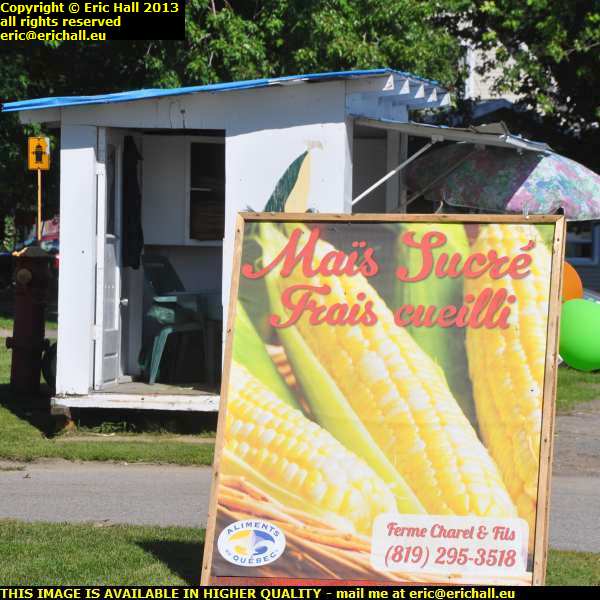
As I drive along the highway and the river, I'm keeping my eye open for interesting and exciting things to record. And amongst the things that I like to see are the signs that are displayed along the side of the road.
Here I've managed to find a sign that is advertising Mais Sucré which, as we all know, is the literal translation of "Maize with added sugar". They don't just call it maïs like they do back in France, or even Mais Doux, which is the literal translation of "Sweetcorn".
And the bit underneath about frais cueilli does not mean "cold-picked" but "freshly-picked", or fraichement cueilli for those of you who speak Français de Paris
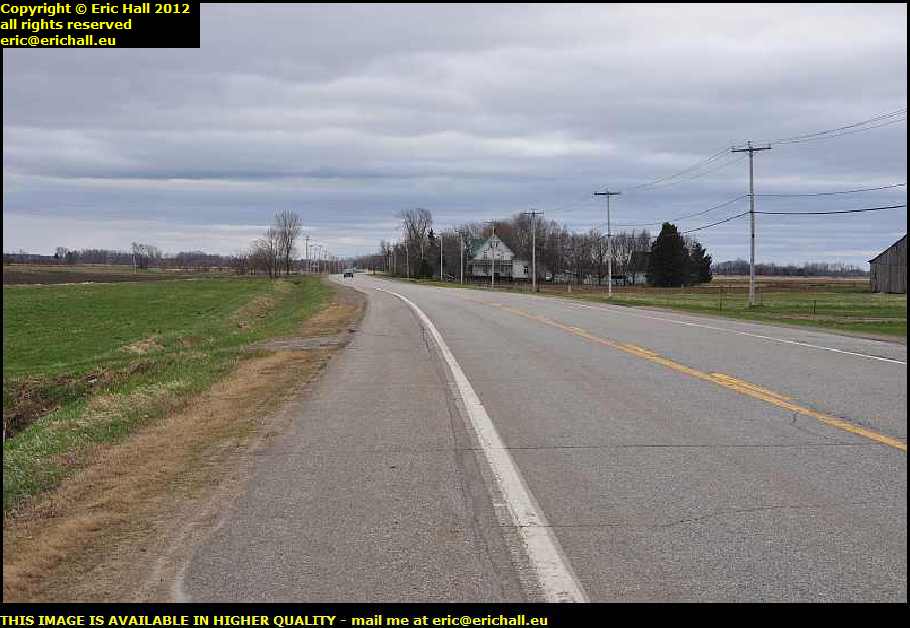
The drive east from Champlain towards Batiscan doesn't seem to be all that inspiring at first - that is, until you start to take a closer look at the surroundings here.
We have the river to the south, of course (to the left in this photo because I'm looking backwards), but there isn't all that much to see anywhere else, except the soil. The soil, though is quite important. You can imagine how fertile it must be with all of the corn that is grown on it in such a short growing season.
What has helped the fertility of the soil in the past is the fact that every year in the spring floods, silt that is being brought down the river from higher upriver is dumped onto the land, hence renewing the soil. As well as that, the soil has been thoroughly soaked by the water, far better than any rainfall or artificial watering could do. All of this gives the new young plants a head start in the growing season.
Modern river management techniques mean that the soil is not being renewed, which means that its fertility is slowly disappearing, leaving the farmers to resort to chemical techniques complete with all of their side-effects. Furthermore, farmers are having to water their crops much more than previously, and that's draining away the water supplies that would otherwise be used for other purposes.
If that's not enough, you might be wondering what is happening to the silt that's not being brought down the river. That is of course all piling up against the lock gates and barrages that are controlling the water flow, and filling in the lakes. In the navigable waterways, dredging is having to be undertaken much more frequently and at the same time, reservoirs are holding less and less water and more and more silt, and hydro-electric generators further upriver are having less and less water and more and more silt passing through their turbines, causing more and more damage and more and more down-time and power cuts.
During the heavy rainstorms in the UK in the spring of 2012, a village in Wales had to be evacuated. The dam just above the village was threatening to burst due to the pressure of water behind it, as the relieving channel was found to be blocked with silt.
I'm not convinced that these modern river-management techniques have been thought through completely.
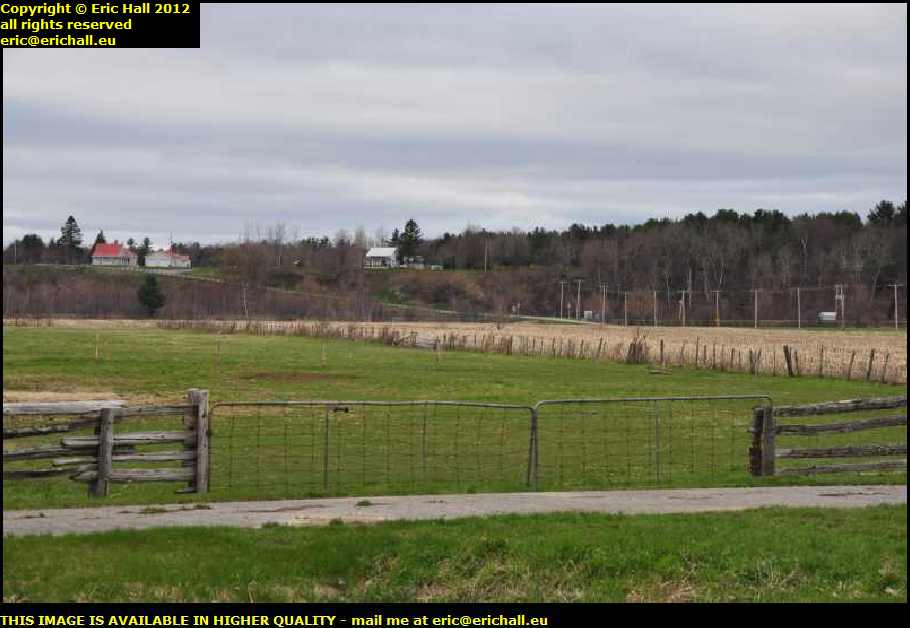
Looking forward from my viewpoint, you'll notice that high bank in the distance. That can be one of two things - either the limit of the flood plain of the St Lawrence, in which case you have to admire the power of the spring floods that could carve that out, or else it's an indication that the river might have changed its course to the south and that is the old river bank.
Seeing the buildings congregated up there would seem to be some kind of suggestion of regular flooding down here on the plain. Farmers don't usually like to be too far away from their fields - it costs them more in travelling and fuel.
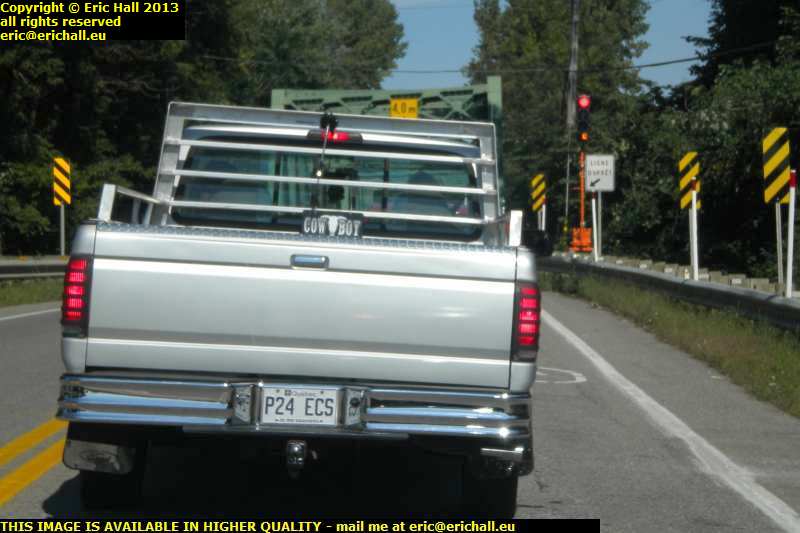
The road between Champlain and Batiscan is punctuated by several rivers - or more like inlets, I suppose. The erosion into the rock has been considerable so they are quite deep and often quite wide.
There'a consequently a whole series of long, narrow metallic bridges such as this one along our route. This bridge is equipped with traffic lights but there are many others that have no form of control at all, and that does not make for easy motoring around here.
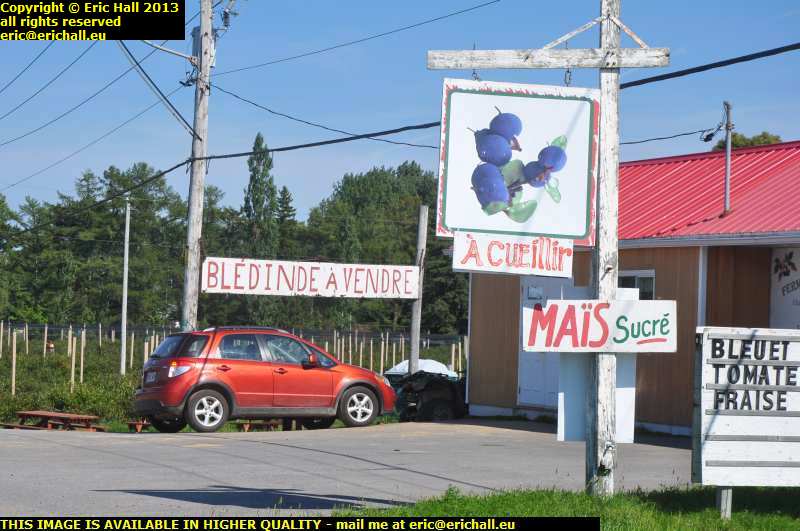
Just over the road from here, not only do we have sweet corn but we also have Blé d'Inde, would you believe? And of course, you guessed correctly that that is Indian corn, which seems to be the staple crop around here.
But this has me just a little confused. Blé d'Inde is indeed "Indian corn", but in the sense that it is corn that has come from the country of India. I'm sure that here in the St Lawrence valley they mean "corn as farmed by the indigenous people formerly and impolitely known as Indians", which should correctly be translated as Blé Indien
©