 | NOVA SCOTIA |
THE FRANCOPHONE COAST

Where Highway 316 swnings round to the west, there's a track that goes straight on, onto a promontory jutting out into the Atlantic, and on here is the small village called Whitehead. This place merited a visit from Yours Truly.
This photograph is of the village on the way in. And what was intriguing me was how on earth he managed to manoeuvre - "personoeuvre" ...ed - that huge boat right up there on that headland.

This photograph is of Whitehead from the other side of the village and you can see the little harbour just here and how pretty it all is. Mind you, the beautiful weather has a lot to do with this. Everywhere looks so much nicer under the sun.
Also on this promontory is a beautiful low ridge that would have a sea breeze from about 250° acting upon it. What price a couple of 500MW wind turbines up there?
And the mystery of how he managed to put that large boat on that headland was solved as well. As I drove around the bend I came across a small road that winds its way up to where the boat is, the boat was on a trailer, and there was a huge 4-wheel drive pickup parked right next to it.
As I drove further round the coast from Whitehead I remarked that it is absolutely beautiful here. There are all these little islands and coves, all that kind of thing, and the waves are crashing in from the Atlantic because, of course, it's the open Atlantic Ocean just here. Nothing for almost 2,000 miles until the Bay of Biscay.

Now here is a surprising thing. I'm at Cole Harbour here and just inland towards Queensport is the site of Royal Canadian Air Force station no5. This was one of 10 set up in 1942 and their purpose was, would you believe, to detect enemy surface raiders and aircraft operating in the area.
I don't understand why they even had one, let alone 10 (it was 10, wasn't it? I'm mumbling again) because personally, I cannot think of anything less likely to occur. The chances of a surface raider making it as far as radar range of here undetected would be about nil and the chances of an enemy aeroplane coming here would be even less.
The only thing that I can imagine what they were defending themselves against was what I would have done if I had been in charge of the Luftwaffe - to bring the war to the Americans by instigating a one-way shuttle bombing to North America, with the crews parachuting out to safety after the attack to be picked up by submarines and ferried back to Europe.
But then again this would have been something that the Luftwaffe couldn't have done more than a handful of times and therefore attacking military targets would be pointless - they couldn't do enough damage with a handful of bombers. They would have needed a propaganda attack and that would have indicated New York as a potential target, not the naval bases at Halifax, St John's or Argentia Bay.
Bearing in mind just how paranoid and panic-stricken the average American is whenever anyone even mentions the word "bomb", a couple of tons of bombs in the centre of Manhattan would have had the USA suing for peace. They can give it out, the Septics, but they can't take it back, but then, that's just typical of most cowards and bullies.
And so I don't know. But I do know that there were "casualties on active service" at some of these 10 or so bases. Died of boredom, maybe, or perhaps they fell out of bed.
Round the bend from here - "a phrase which is far from inappropriate" ...ed - we come back into bilingualism - and French bilingualism at that for I notice that around here everything seems to be French-speaking.
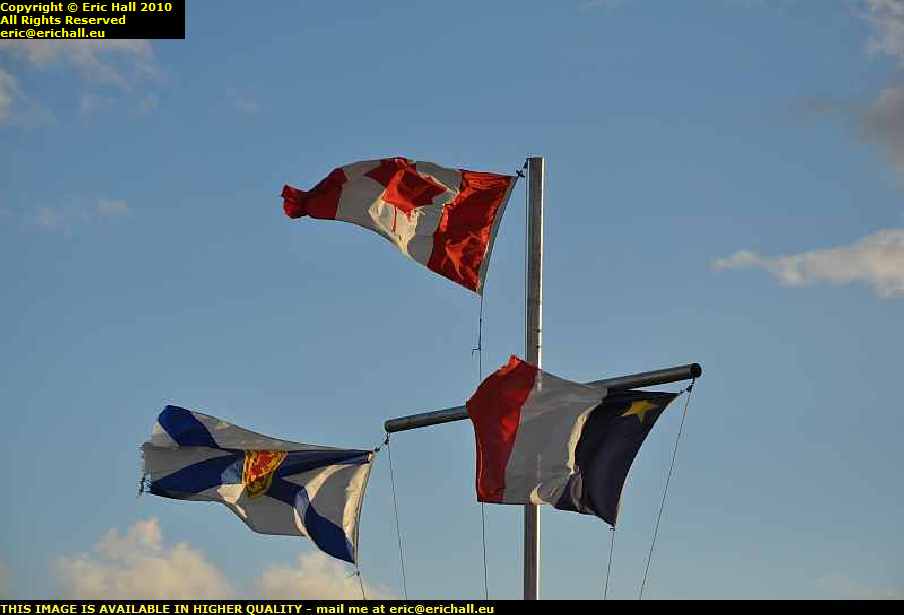
I'm greeted here at Larry's River, for that is where I am, by a flagpole displaying the Canadian flag, the Nova Scotian flag and the "Star of Acadia" and although I can't be sure of this, it may well be the first "Star of Acadia" that I have seen on my travels this year.
Back in 2004 there was a festival in this part of Nova Scotia, something to do with the re-awakening of the culture of the area, organised by the Tor Bay Historical Society or whatever it might be called. And of course the Acadians - the original French colonists of Canada - were quite strong in this area before their expulsion when the British took over.
And while I was musing on all of this, I drove all the way round Tor Bay and out the other side, forgetting completely why it was that I had actually come here.
I talked considerably - "you? Perish the thought!" ... ed - a short while ago about the various transatlantic cable companies bringing their cable ashore in this part of Nova Scotia. The Direct United States Cable Company, which I briefly mentioned in passing, brought its cable ashore here in Tor Bay in 1874 and set up what became known as the Faraday station here. It was the first company to attempt to breach the monopoly of the cables to Newfoundland.
The cable that it used was, well, primitive in design, being the earliest of the cables to Nova Scotia, and rapid advances were made in cable technology during the next few years. With more modern cable the Western Union and the Commercial Cable Company could offer a more reliable service and the Direct closed down under the onslaught in 1887.
Its rather ephemeral existence made me doubt that there would be very much to see here in Tor Bay today but nevertheless I ought to have gone to look around.
There are a couple of villages just along here called New Harbour Something and New Harbour Something-Else (do you like my precision?) and to connect them they have built a new road across an arm of the sea.
With a causeway like that having been built especially for me so it seemed, because I had the impression that there had been nothing here before, I had to drive across it instead of taking the long way around.

From there, it's over the top of a headland and around the shoreline on my way to Goldboro, and having talked just a little while ago about little islands and coves and the like, here's a splendid example of exactly what I mean.
From the top of a subsequent headland a little further along the road there's this really beautiful view just here - a small village and church over there that is jutting out into the river on a promontory. Now that's what I call "pretty"
It will however not have escaped your notice that the light is now starting to go. I am going to have to get weaving.

My next stop is a place called Goldboro. Here we are at the parking area at Gold Brook Road. with the township of Isaac's Harbour, whoever Isaac might have been, just across the bay.
With a name like Goldboro, you might expect it to have some kind of gold-mining history, and you would be right. Unfortunately the gold didn't pan out like it ought to have done and it wasn't all that successful, for the town is now pretty much decayed. Some of the houses are derelict and I reckon at a quick glance that about 50% of the properties here are up for sale.
However, said he, drawing a deep breath, there is some kind of 21st Century industry here at Goldboro.
You may remember that, when I was at Mulgrave I encountered a Liquid Natural Gas pipeline, and a little later when I was at Canso I was musing on the fact that the only way that these communities will ever recapture their lost wealth is to strike oil off the coast.
Just about 200 kilometres off the coast here is Sable Island - not really much more than a sandbank, I suppose but it has wild horses and other animals, mainly the survivors of shipwrecks, and the whole place has been declared some kind of Nature Reserve with access to the island being very stricly controlled.
Although they haven't yet managed to strike oil, it seems that they have found a natural gas field just off the shore of Sable Island. As a result, they have created what is known as the Sable Offshore Energy Project and the gas is pumped ashore here at Goldboro. There's a separation plant here and the liquid products are pumped along the pipeline to Point Tupper, with the pure natural gas being piped west to the major centres of population.
Yes, fancy that! A nature reserve having the temerity to be in the path of a fossil fuel exploitation site! Quick - where are the wind turbines?
Pushing along through the doom and gloom around the top of Isaac's Harbour I suddenly encounter a sign - "Highway 211 - Country Harbour Ferry 4kms". Now ferries and I - we are legendary and who can forget my voyage along the North Carolina Coast in 2005 when I went out of my way to drive across every ferry that I could find?

"Ferries every hour on the hour - last ferry 18:00", so it said. It was 4kms away, and it was now 17:55. I'd better put my skates on. This is not the time for hanging about. Luckily I can move when I'm in a hurry and I made it to the terminal with just 30 seconds to spare
Just in case you are wondering, this is a photo from the other side of the bay after my disembarkation. I didn't waste any time to stop and take a photo before I boarded.

Having shown you a photo of the other side of the bay, I suppose that I had better show you a photo of this side. That's the ferry terminal, such as it is, over there on the shoreline.
You pay for the ferry on board ship and I can't remember now how much it cost me for the voyage, but I do know that it was nothing like the price that you would pay for a aimilar ferry crossing in the UK, for it is a Government ferry run by the Department of Transportation and Infrastructure Renewal.
You'll also note that Casey is the only vehicle aboard. And I am the only passenger.
The crossing is 760 metres, by the way, and sails from a site that was once known as Mount Misery, due to the fact that a party of colonists from the UK settled here and so harsh was their first winter that not even a handful survived.

I say that I am the only passenger, but of course that isn't quite correct. I am not alone, but have the world-famous Strawberry Moose with me on my travels.
No voyage is complete without His Nibs posing for a photo opportunity, and so here he is in the company of Seaman Staines aboard the Good Ship Ve ... errrr ... Stormont.
What do you make of the lifeboat in the background? I wouldn't like to confront a hard nor'easter in that. It would certainly benefit from a coat of paint, and I hope that the rest of the life-saving gear is better-maintained than that.

In view of his legendary reputation, His Nibs is invited to make an official inspection of the vessel and watched by Master Bates and Seaman Staines he takes the controls for the journey across the bay. He was rewarded with a Nova Scotia Ferries cap for his efforts.
The crew of the vessel was quite knowledgeable about the ferry service. It's a chain ferry of course and with a capacity of 12 vehicles. It is worked by a hydraulic winch that is powered by a 4-cylinder diesel engine. So much for my idea about electricity.

The crossing looks quite calm and peaceful in the setting sun, don't you think? But it wasn't always like this and if you had come by here in 1753 you would have found things to be quite different.
On 21st February of that year a small British ship, with a crew of just 4, was sheltering in the bay when the crew was taken by surprise by a party of 9 Mi'kmaq, incited by a certain Father Le Loutre, one of the leaders of the Acadian inhabitants who were resisting the British Oath of Alleigance. Two of the crew were killed and scalped, and the other two were taken captive.
As an aside, when the English were looking at suitable sites to build a fortess to challenge that of the French at Louisbourg, Country Harbour was one of the leading contenders. However, the choice eventually fell on Halifax.
Not only was the crew of the Good Ship Ven ... errr ... Stormont knowledgeable about their ship and the ferry service, the personnel were also knowledgeable about the local area. On discovering that I was on my way to find accommodation for the night, they directed me to a small Bed-and-Breakfast establishment just along the coast.

And I will say now that if I can ever find better value than this bed-and breakfast for just $45 per night all-in then I shall move in there permanently.
Like everyone else that I have ever encountered on any of my voyages around the Maritimes (with the exception of those people in that museum - The Rooms in St John's), the proprietors were extremely friendly, helpful and knowledgeable.
Furthermore, although they were Anglophones, the guy here had been a cop in Québec and so was perfectly bilingual and also had some kind of empathy with the Francophone communities around here.
They moved here about 30 years ago and in that time they reckon that not a week goes by without someone leaving the area to move elsewhere, such has been the consequence of the collapse of the economy following the decline of the fishing industry. They recounted a long, almost endless list of local businesses that had gone - the loss of the local grocery stores being the most painful and now they have to travel miles for their food supplies.
It sounded every bit as depressing as the stories that I heard when I bought my house to the Auvergne in 1997 , with the desperate decline in population there in the 1960s 70s and 80s. Of course the situation there is now in reverse with a slowly-increasing population and I would have liked to have encouraged them about that, but of course the situation in rural France is different.
The French Government has realised that the way to build up the population in an abandoned rural area is to market its advantages - wide open spaces, beautiful scenery, plenty of land, cheap house prices and so on - to places where acommodation is vastly overpriced and where the people are so stressed out that they are craving for a return to the simple life, living a minimalist existence with no worries and no cares.
Not a week goes by without hearing of some new Brits or Dutch buying an abandoned cottage with an acre or so of land to live off, fixing up the property, living off their vegetable gardens and the proceeds of the sale of their vastly-overpriced houses back in their home countries.
The French took further steps in the right direction by relaxing the regulations with regard to self-employment and now many foreigners (Yours Truly included) are now running tiny cottage industries, and so the economic life of the area is slowly improving.
What is interesting in this for the French Government is that the money coming into the area and refloating the economy is not French money at all. It's not costing the French economy a single centime. It's money flooding in abroad, from countries such as the UK and the Netherlands, so it is increasing the overall stock of money available to France and building up the nation's wealth and draining the wealth of their neighbours.
At the last count, there are 1,100 British households within a 30-mile radius of St Gervais alone, and easily just as many Dutch households. If each one of these foreign households has spent just €100,000 on buying, renovating and equipping its home in the Auvergne, that's €220,000,000 that has come flooding into the coffers of the local Auvergnat economy and it hasn't cost the French a penny.
Then, of course, add on to that the other items. Money that the foreigners have brought with them from the sale of their properties in the UK and the Netherlands, retirement pensions from those countries being spent in Auvergnat shops creating wealth and employment for the locals, all this kind of thing. The French have got it absolutely right and hats off to them.
Of course this won't ever happen in Canada because of the immigration regulations here, and it is just so short-sighted as to be untrue. If ever the Canadian Government would lift the blinkers just a little and see the benefits that comfortably-off middle-class early-retirees from Europe, sick of the degradation of the quality of life over there, can bring to their country, and then do something about it, the situation would change dramatically. If the French, known the whole world over as being obstinate and blinkered, can see the light and do it in spades, why not the Canadians?
If the Canadian Government were to say that anyone who puts down $200,000 cash and is willing to move to the Maritime Coast could have the unrestricted right of admission to the country, I would be here tomorrow. And so would many others.
You might think that this is something of a revolutionary idea and I did say just now that "this won't ever happen in Canada" but just 5 minutes of subsequent research showed just how wrong I was, and how wrong you might be too.
On January 17th 1900, The Superintendent of Immigration in Toronto made a report to the effect that during the year 1899, something like 14,000 Americans immigrated into Canada, bringing with them a total of about $2,000,000. That wasn't an insignificant sum of money back in those days and he clearly knew the value that that kind of money could bring to the Canadian economy.
And so having now finished my rant, and what a good one that was, let me return to my story.
I was also interested in the local Francophone communities around here too, having just driven through one. He told me that there were two, Larry's River, which I had just driven through, and Chato's Land, or something like that, around here. He reckons that they are slowly losing their Acadian identity becoming much more Anglophone, and that this is quite a shame.
And so maybe that was what this Nova Scotia festival thing was all about - reawakening the dying spirit of Francophonia.
And did you notice a very clean Casey there in that photo? It's a far cry from how he looked over in Labrador . It's the rain that has done that of course.
©