 | CAPE BRETON ISLAND |
THE BRAS D'OR
Off on the northern side of the bay, it was quite strange retracing my steps after all this time. I'd remembered the road from 2003 and knew that the turning was along here somewhere. I also remembered that it looked quite attractive in the half-light back then. I hoped that it was going to live up to my memory.

"Quite attractive" I said, didn't I? What do you make of this?
This is the Cabot Trail going south - if you want to go north you need to go to this page - about a mile along the road in the direction of Baddeck and it's probably even more beautiful than I remember it from my earlier visit. Mind you, it was early December when I was here back then in 2003 and there were no leaves on the trees. The presence of leaves today certainly makes a difference to the scenery, what with all of the autumn colours.

We talked a little while ago when I was in Cartwright, Labrador about bilingualism in Canada and the lack of official encouragement given to First Nation languages. In this area, as we have already seen, there was a large resettlement of the population of the Highlands and Islands of Scotland where Gaelic would have been the first language, and you will note that many of the signs here are actually bi-lingual in Gaelic.
Even more surprisingly, it seems that it is the official signs that are bi-lingual. I had a look at all of the unofficial signs that I could see - roadside advertisements, yard sales, holiday accommodation and so on, and sad that it is to say it, for I'm all in support of maintaining one's culture and language in a foreign environment, all that I could see were written in English only.
It's strange to me that the official signs here are allowed to be bilingual even though the local people don't appear to be speaking it in public, and yet in many First Nation communities where people are publicly (so I am informed) speaking their traditional language, the authorities give no official encouragement to those languages.
Somewhere on my travels, I mentioned this to someone. I was told that apparently it's only the local officialdom - not the national officialdom - that encourage the bilingually-Gaelic signs. A local radio station once started a series of programmes in Gaelic and a large heavy object landed on the heads of the team, thrown all the way from Ottawa.
That was something that I found quite extraordinary. Canada is awash with anti-anglicism, coming mainly from the Francophone community. There can't surely be a more-chauvinistic linguistic group, when it comes to protecting its language, than the French, especially when it comes to the infiltration of idiomatic English. One would have expected any community, doing its best to counter the pervasive spread of the English language in the wilds of rural Canada, to receive nothing less than 100% support from the Francophone community, but apparently not.
Anyway, as you probably know, I write, produce and co-present a series of English Language radio programmes for the ex-pat Brits on French local radio, and I'm still here to tell the tale - "so far" ...ed. And the little devil inside my head made the suggestion that it was not unreasonable to suppose that the invective received here from Quebec might have had something to do with the fact that somewhere along the line the use of the French language might have been ... errr ... overlooked.

whilst I was musing on the aforementioned, I came across a cemetery just a short way down the road. This is the North River Bridge (I think) Pioneer Cemetery.
As you know, if I have time I love to go for a wander around cemeteries in areas such as this because you can learn so much history from them. And as I was wandering around here I did wonder to myself why it was that it was called a Pioneer Cemetery, because the earliest grave that I could see was dated 1849. For a Pioneer Cemetery I was half-expecting to see a headstone from the end of the 17th Century or something like that.
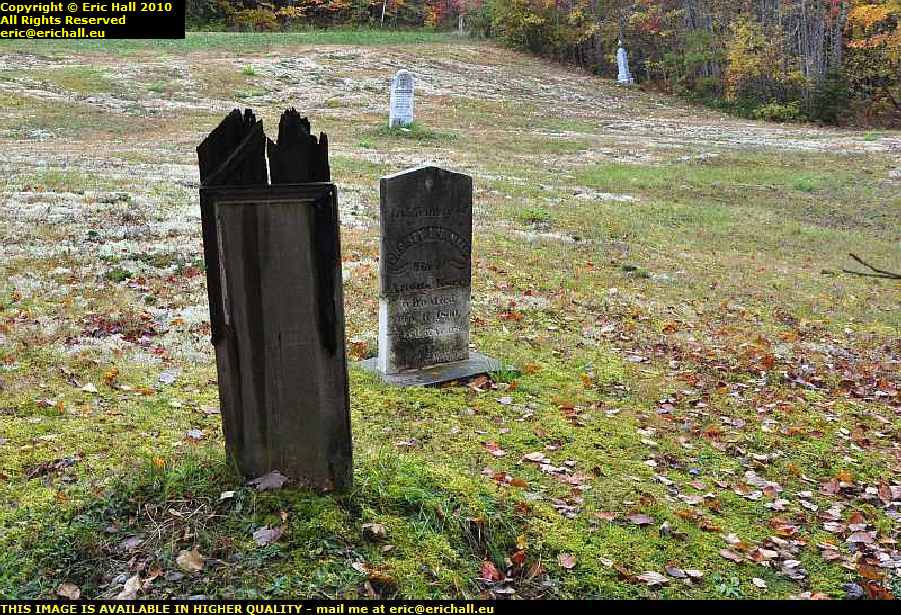
Mind you, for all I know there could be many earlier graves in here that are not recorded by headstones. Many of the headstones are in a deplorable condition, such as this one, and so it's quite possible that many others have disappeared completely.
The wide-open spaces in the cemetery could indicate an enormous number of unmarked graves - they wouldn't close the cemetery down (the last headstone that I saw was dated 1890-something) and open another one just down the road as they have done here for no good reason, and the best reason would be that the existing one was full.

From what I could see, all of the names in the cemetery were again Scottish as you might expect and I made a note on my dictaphone (I go all hi-tech when I'm travelling) to wax lyrical about the fate of the pioneers in an area like this because so many of the people interred here were quite young.
The sea claimed its share of the victims as you might expect, close to the coast of the Maritime Provinces. There is a grave here of someone who was, would you believe, lost at sea (and I am not making this up either) and his wife, contrary to the average of the ages in here, lived on to what was a respectable age for the 19th Century round here. And she wasn't the oldest either. There was a woman in here who, despite everything that this area could throw at her, clung on to reach the age of 93.
Leaving the cemetery, I did recall the story that I had heard of an American tourist visiting a Scottish Pioneer Cemetery somewhere around here. He noticed a particular gravestone that commemorated "Hamish MacTavish, a loyal husband and devoted father". The tourist turned to his wife
"Isn't that just like the Scots? Burying three men in one grave!"
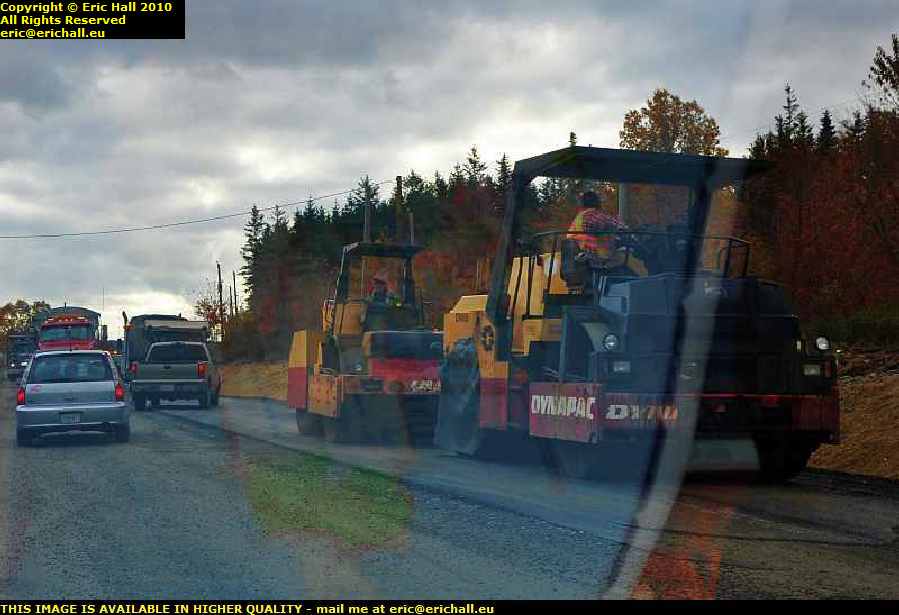
Here at St Ann's I encountered some absolutely huge roadworks. They seem to be completely rebuilding this road here and we aren't just talking of a hundred metres or so, I measured it and they stretch for 5 kilometres or so.
It was nice to see some graders again too, I was beginning to miss them. We also have compactors too, as you can see if I don't get the rear-view mirror in the way of the shot, and not just one but in these 5 kilometres of road works I counted 5 of them. Strange as it is to say it, but in the whole of the, ohhhh I dunno - 2000 kilometres that I travelled around the Trans-Labrador Highway and associated trails where they could really do with a fleet of compactors, I counted a grand total of just three!
Clearly everyone here on this site is on piecework. I'm not in any particular hurry but I was chased down the road by a tipper lorry and he was not impressed at all when I stopped to have a look at out next attraction.

I told you that Gaelic seems to be the big semi-official thing here and so we have the Gaelic College at St Ann's, founded in 1939 to promote the Gaelic language and heritage.
What kind of Gaelic heritage they are promoting though is something that remains open to question. First thing that you observe upon entering the college is Ye Olde Gifte Shoppe and the first thing that you observe in Ye Olde Gifte Shoppe is the announcement that you can choose your own kilt in your own tartan.
As I say, what kind of heritage is this? It is quite true to say that the clans of Scotland did have certain colours and combinations thereof as a certain kind of trademark, but that was down to the dyes that were available from the plants that grew in the particular areas that they inhabited (we are talking long, long before Aniline dyeing) and was no part of any plan. The clans were quite susceptible to changing the colours that they used if they moved into another area and found a different range of plant types growing there from which different dyes would be extracted.
This fashion of associating names and designs to various clans is nothing more than a dismal Victorian invention designed to humour Queen Victoria on her first state visit to Edinburgh. Victoria was amused and so the fashion developed, even to the absurd lengths of wearing dinner jackets with kilts, something that your average Scots crofter wouldn't have even recognised, let alone worn. And all of this was of course long after the clans had been evicted and dispersed to the four winds.
There was a woman in attendance here and so I asked for the details of Gaelic course. Her response was
"it's all on our website".
Translated from the Ancient Gaelic, that means
"I don't have a clue about the language courses and I have no interest in finding out. I'm just here to sell you an invented tartan in the colours of whatever invented clan we have managed by whatever dubious means you like to insinuate your surname, or some other highly improbable Gaelic souvenir so that you can pretend to your friends back home that you did something really exciting and unusual".
That, I fear, tells you all that you need to know about the Gaelic College at St Ann's. I worked far too long in the tourist industry not to recognise a tourist trap whenever I see one. I was really dismayed by this place, and in the best traditions of News of the World reporters everywhere, I made my excuses and left.
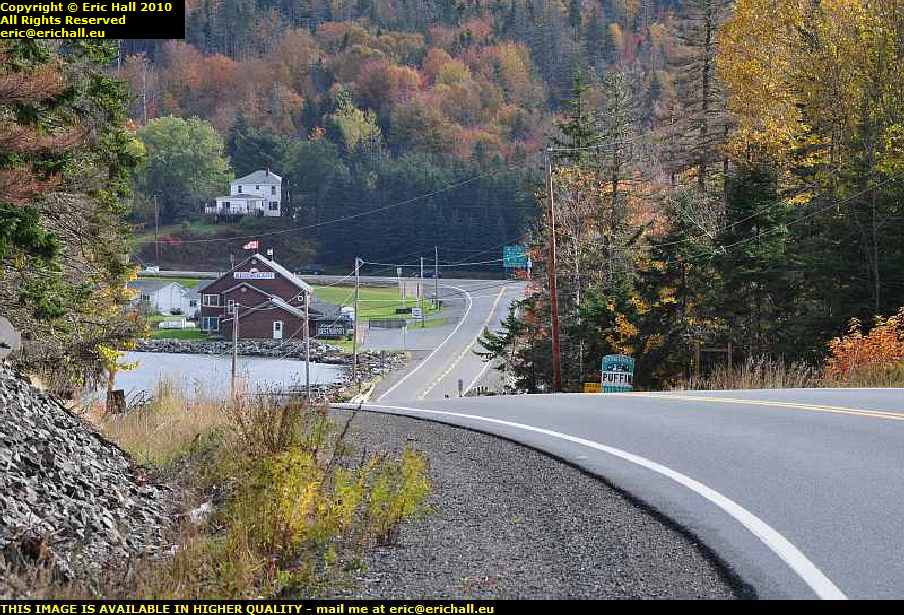
Just round the corner from the Gaelic College I can see the Trans-Canada Highway and that will be where I'm going, turning right in the general direction of Baddeck and that looks quite scenic as well.
This marks the end of the Cabot Trail and I do have to say that the detour was quite interesting one way or another. What with road works like in Labrador, pioneer cemeteries and the Gaelic issue, there was certainly a great deal to see and do. And that was before I even started on the scenery.

I stopped on the causeway to have a look at the view downstream towards the sea. That's St Ann's Bay that I have just driven around, and the Englishtown Ferry is somewhere right up there. You can see what I said earlier about this area being one of the most spectacular parts of Cape Breton Island. It really is beautiful and I was glad that I took the time to drive along there
However, my reverie was interrupted just here by another one of this most extraordinary phenomenon of the Canadian Marching Woman. I've seen dozens of these while I've been on my travels and I would love to know why they do that.
Back on the Trans-Canada Highway I eventually arrive at Baddeck, which is where I wanted to be in the first place before my delightful little excursion. There's a sign just outside the town saying something along the lines of
"Welcome to Baddeck - Home of the Silver Dart - The Birthplace of Canadian Aviation"
and so this has to be interesting
Of course, Baddeck is much more famous as the home of the inventor of the telephone, Alexander Graham Bell (or Alexander Bell to be more precise - the "Graham" was added when he was about 10 or 11 in honour of a family friend, one Alexander Graham). With his renowned interest in all things technical and in a small place like this, you would think that there might be a connection between him and the Silver Dart, and you would be correct.
The Silver Dart was a plane built in the USA in 1908 by a group known as the Aerial Experiment Association, a group inspired by Bell and which included such luminaries as Glenn Curtiss. Another member of this group was Lieutenant Thomas Selfridge, whose claim to fame is that he went down in aviation history as the first person to be killed in a plane crash, when flying as a passenger with none other than Orville Wright.
In fact Selfridge's association with the AEA was shrouded in controversy - the Wrights claiming that he had stolen some of their ideas which were subsequently incorporated into the design of planes built by the AEA.
But then again the Wrights were notorious for the aggressive way in which they attacked the aviation industry back in the early days of flight, and some allege that they set back aviation development in the USA by 10 years. Aviation writer Walter J Boyne wrote that ... the Wrights did almost as much to set aviation back as they had done to bring it forward .
It is said that they demanded a royalty of 20% of the profits on all planes sold in the USA and picketed air shows until the exhibitors paid them "royalties" in lieu of being sued for patent infringement, stories that have their parallel today in the nitty world of hi-tech gadgets. There were numerous other stories about their high-handed techniques in dealing with aeronautical rivals, therefore the claims of the Wright Brothers with regard to the activities of the AEA should be treated with caution.
But anyway, I digress. The Silver Dart was the fifth plane to be built by the AEA and once it had been successfully tested, it was crated up and brought to Baddeck. On 23rd February 1909 it took off from the frozen surface of the lake and flew into history as the first flight in Canada. It's claimed quite frequently that it was the first flight in the British Imperial domains, a claim that would surely come as something of a complete surprise to a New Zealander by the name of Richard Pearse.
Now, at the risk of being controversial - "You, Eric? Surely not!" ...ed - there are many pioneers in aviation history (Richard Pearse and Gustave Whitehead being just two in a very long line) whose early attempts at flight have been ridiculed by modern historians, because modern reconstructions of their aircraft flown by modern pilots have not succeeded in emulating the feats that were claimed for them at the time.
But it is a fact that the "Silver Dart" flew for a respectable distance (I've seen half a kilometre, almost a kilometre, a kilometre as figures claimed for the flight) in front of a crowd of people, some of whom were scientists whose powers of observation cannot be reasonably be called into question. And yet for the centenary celebrations of the flight, a modern replica piloted by a modern pilot took off
"and flew for about 10 metres before setting down" according to the Canadian Press. This demonstration of modern aeronautical prowess tells us everything about these so-called "replica flights" and the proofs that they can offer about contemporary conditions.
To further enlarge upon the subject, let me leave you with I story that I was told about Lindbergh's plane, the Spirit of St Louis.
I have been lucky enough to sit in the pilot's seat of the replica of this plane
and I recall the words of Paul Mantz, the famous stunt pilot and mate of the controversial Amelia Earache. He was the sponsor of the replica of the Spirit of St Louis and when it was completed, he took it for a spin. His subsequent opinion was that
"it was absolutely hideous to fly and I could not understand how they had gone so far wrong when they built the replica"
Next up was Charles Masefield. He was luckier than I was in that he also had the chance to fly the plane. He called it
"an absolute heap. It's completely unstable, controls unco-ordinated, ailerons enormously heavy, elevator terribly light, rudder totally ineffective, you can't see where you are going, the engine vibrates like mad and there are hardly any instruments"
However, the final word on this goes to Lindbergh himself. He took the replica up into the air and flew it for over an hour, probably the only example of a contemporary pilot flying a modern-day replica of his own personal machine. Although having once famously described his own plane as feeling
"more like an overloaded truck than an aeroplane" on his trans-atlantic take-off, his comment upon landing the replica was
"Do you know? I had forgotten just how nice that little aeroplane was! You've got it exactly right. Not quite up to modern standards of course, but it flies just like the old Spirit did"
This just goes to show that contemporary pilots were made of much sterner stuff than the modern-day variety.
In other words, these "replica flights" prove nothing at all and no-one should take them seriously as a means of scientific research.
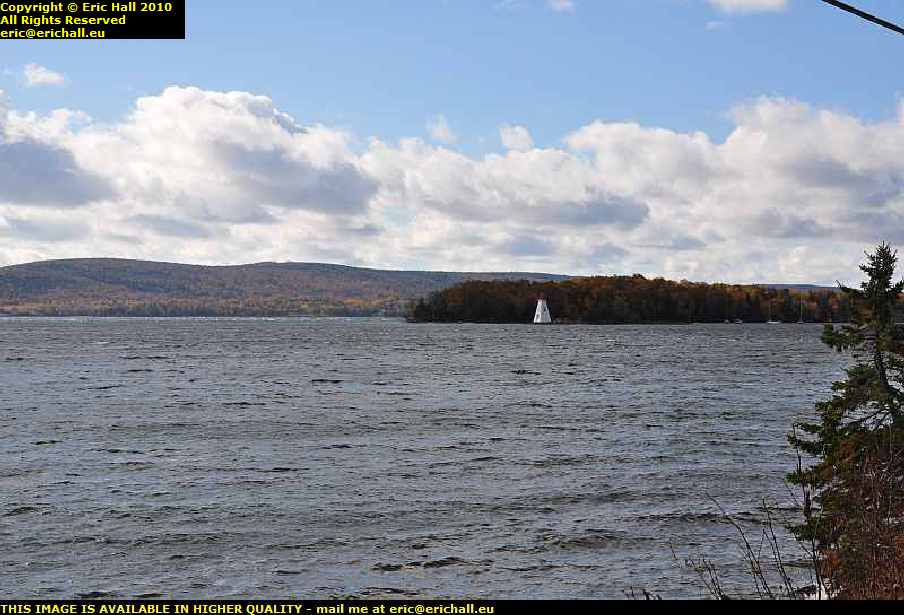
And so having disposed of the aviation issues, I can finally concentrate on the town itself. The approaches to Baddeck are really quite beautiful and being greeted by a view such as this makes the journey all that worthwhile.
On the right of the little lighthouse over there is the entrance to St Patrick's Channel and when I find my "Cape Breton Pilot - Guide for Yachtsmen to the Cape Breton Inshore Waters" that I picked up in a junkshop in Amherst, I can tell you much more about it.
Just after this I come across the Alexander Graham Bell Museum and to my complete and utter astonishment, if not surprise, it is actually open to tourists. That must be a first as far as I am concerned.
The downside though is that it costs $7:90 to go in and what with me being on the economy budget and having vastly overspent already, I'm afraid that that was ruled out. But not to worry - I'll be back here again - nothing is more certain than this.

I enquired of the friendly and helpful personnel if this was actually the home of Bell, but she pointed out the promontory over there and said that his house was over there, underneath the tallest tree on the promontory, and he is buried over there too, on Beinn Bhreagh Mountain which was also part of his estate.
I asked if it would be possible to go over to see it, but apparently not. It's still owned by Bell's descendants who use it as a holiday home, and it's now part of a gated community.
But a gated community in the middle of Cape Breton Island? Whatever is this all about?
I had a drive through the town though, but there wasn't really a focal point or significant object to photograph and so you will have to do without one. It's just a typical Maritime Province small town the same as any other - I could show you any photo from any other town that I've visited on my travels and no-one would know the difference.
I was however comforted by the fact that there were ... ohhhhh, easily half a dozen motels here. Not quite the 200 Motels
But I did hear an exciting story about a motel in Baddeck. It seemed that some Government scientists were controlling the population of the deer, and this control included some dissection of samples of culled animals. For reasons best known to themselves, they did this in the bathroom of their motel room.
The final night of their visit, they celebrated their impending departure in the usual fashion of Government employees everywhere, forgetting about the dismembered beast in the bath. Next morning they were in no condition to attend to it and so they slipped the chambermaid what is known in the usual circles as "a well-filled plain brown envelope" to deal with the matter herself. She quite sensibly dealt with the matter by pocketing the envelope and sending for the management. As a result, Government employees are banned from from one motel in Baddeck, but my enquiries have failed to discover which one it is.
Therefore, if you are a coming to stay at a motel in Baddeck, you are best-advised not to mention the nature of your employment, just in case.
©